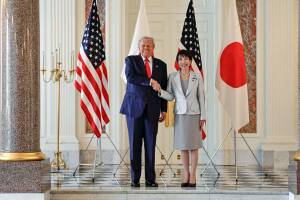
President Donald Trump shakes hands with Japanese Prime Minister Sanae Takaichi during his official visit to Tokyo.
By the SHR Media Staff
October 27, 2025
President Donald Trump’s Asia tour has blended diplomacy, defense, and trade in what the administration is calling a “peace and prosperity mission.” The trip opened in Southeast Asia with the signing of a peace agreement between Thailand and Cambodia, followed by new mineral supply-chain deals, and concluded in Tokyo with historic gestures from Japan’s new Prime Minister Sanae Takaichi and a suite of new U.S.–Japan agreements.
Peace Deal Between Thailand and Cambodia

President Trump helped broker a cease-fire agreement between Thailand and Cambodia to end years of intermittent border clashes. The accord includes commitments to remove heavy weapons and landmines along the disputed frontier and to allow regional monitors from Malaysia to oversee compliance.
Cambodia agreed to release 18 detained soldiers as part of confidence-building measures. The deal was paired with new trade arrangements linking peace and commerce—Thailand committed to major purchases of U.S. agricultural and energy products as well as U.S.-made aircraft.
A key component of the negotiations included guarantees that Thailand and neighboring nations would not restrict or impose quotas on exports of critical minerals and rare-earth elements to the United States, a move aimed at securing non-Chinese supply lines for technology and defense production.
While the agreement is being praised as historic, some regional analysts note that it builds on earlier truce frameworks and leaves certain border-demarcation issues unresolved.
Strategic Mineral and Trade Agreements
Throughout the Asia trip, the White House emphasized the creation of resilient supply chains for critical minerals and rare-earth materials. The United States signed framework agreements with Thailand, Cambodia, and Malaysia ensuring open access to key resources vital for clean energy and defense manufacturing.
In parallel, Japan and the U.S. announced a major rare-earth partnership focused on mining, processing, and stockpiling to reduce both countries’ reliance on China. The deal includes cooperative investment between Japanese industries and U.S. energy-technology firms.
Focus on Japan: Alliance Strengthened
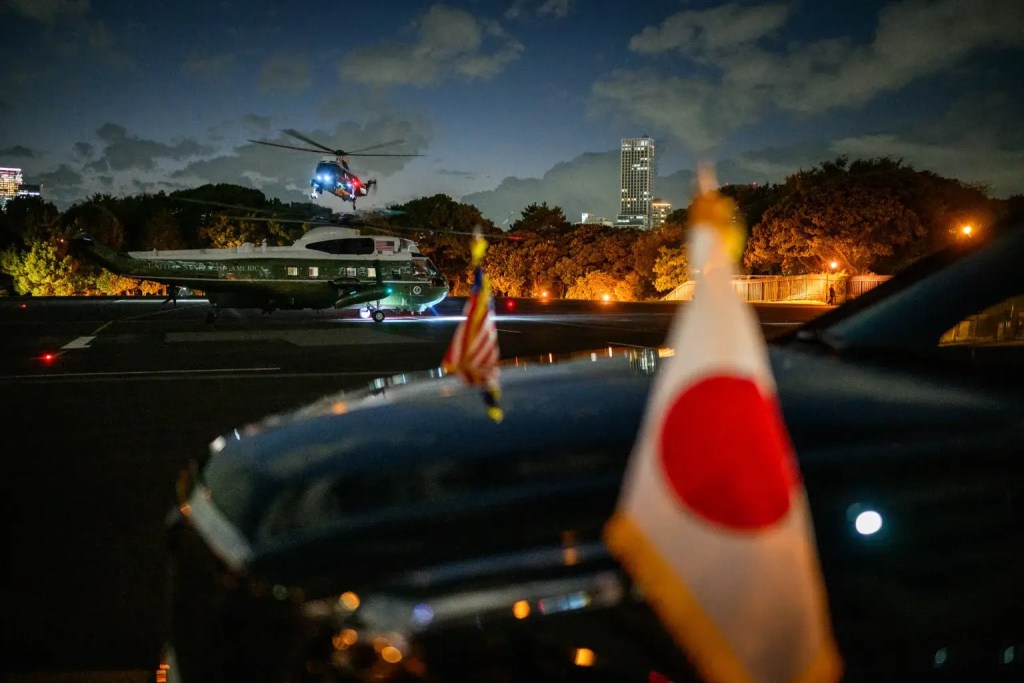
In Tokyo, President Trump met with Japanese Prime Minister Sanae Takaichi, marking the first visit between the two leaders since her election. The meeting underscored the enduring alliance between Washington and Tokyo, blending symbolism with substantive agreements.
A Gesture of Legacy
Prime Minister Takaichi presented President Trump with former Prime Minister Shinzo Abe’s gold-plated golf putter—one of Abe’s personal items symbolizing friendship and continuity in U.S.–Japan relations. She also gifted a golf bag signed by Masters champion Hideki Matsuyama.
That evening, Tokyo Tower and the Tokyo Skytree were illuminated in red, white, and blue lights to celebrate the visit and reaffirm Japan’s alliance with the United States.
Trade and Defense Deals
The two nations finalized a reciprocal trade and defense package. Japan will increase its investment in U.S. industries by approximately $550 billion while the U.S. adjusts reciprocal tariff thresholds to 15 percent.
Japan also agreed to raise its defense spending to 2 percent of GDP and expand purchases of American-made defense equipment, reinforcing joint military production and interoperability.
Additionally, the U.S. and Japan signed a comprehensive critical-minerals cooperation agreement covering mining, separation, refining, and stockpiling—cementing Japan as a cornerstone partner in the Indo-Pacific supply chain strategy.
Editorial Disclosure
This report was written and edited by the SHR Media Staff. All information is drawn from publicly available government statements and verified reporting as of the date of publication.
While every effort has been made to confirm accuracy, details related to trade-deal enforcement mechanisms and investment figures remain subject to official release by U.S. and Japanese authorities.
This article reflects factual reporting only and does not constitute an endorsement of any political policy or party.
About the Author

Discover more from SHR Media
Subscribe to get the latest posts sent to your email.