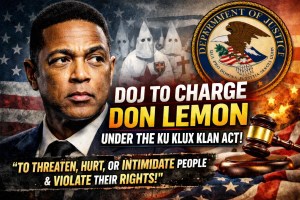
Claims circulate that the Department of Justice is reviewing potential Ku Klux Klan Act violations connected to Don Lemon’s presence at a disrupted church service, though no formal charges have been confirmed.
The Department of Justice has announced its intention to pursue charges against Don Lemon under the Ku Klux Klan Act of 1871, following his involvement in a coordinated protest that disrupted a church service in Minneapolis.
The announcement and legal rationale were discussed publicly on The Benny Show, hosted by Benny Johnson, during an interview with Harmeet Dhillon, Assistant Attorney General for Civil Rights. The episode included contemporaneous video footage of the incident involving Lemon and the activists.
Why Federal Civil Rights Law Is Being Applied
The Ku Klux Klan Act is a federal civil rights statute designed to address conspiracies that intimidate, threaten, or interfere with citizens exercising protected rights. That protection explicitly includes the right to worship freely without harassment or disruption.
According to the Justice Department’s Civil Rights Division, the statute applies when individuals coordinate actions that interfere with those rights, regardless of whether physical violence occurs. Intimidation, obstruction, and organized disruption fall within its scope.
The incident in Minneapolis involved activists entering a church during a worship service and disrupting congregants inside the sanctuary. Don Lemon was present inside the church during the disruption and documented the event in real time.
Media Status Does Not Confer Immunity
Federal civil rights law evaluates conduct, coordination, and participation. It does not exempt individuals based on profession, media affiliation, or claimed journalistic purpose.
Presence inside a protected space during an active disruption, combined with documented coordination and real-time narration, places an individual within the factual framework prosecutors evaluate under conspiracy-based civil rights statutes.
That distinction is central to the DOJ’s analysis.
Enforcement Warning to Protest Groups
During the interview, Dhillon made clear that federal enforcement is not theoretical. She stated that protest groups engaging in coordinated actions that interfere with protected rights should expect aggressive federal response, including felony charges and lengthy prison sentences where applicable.
The message was explicit: organized disruption of religious worship triggers federal civil rights enforcement.
Why This Case Matters
The Ku Klux Klan Act exists to stop intimidation campaigns masquerading as political activism. It exists to protect citizens when mobs decide that disruption should replace lawful dissent.
Churches are protected spaces. Worship is a protected activity. Civil rights enforcement does not pause because a participant claims to be reporting rather than participating.
If the facts support application of the statute, enforcement is not controversial. It is required.
“The Reaver of Common Sense”
Jersey Joe is the host of The Reaver of Common Sense on the SHR Media network. The opinions expressed in this article are his own and reflect a commitment to primary source research and constitutional literacy. For those looking to dive deeper into the documents and debates mentioned here we encourage you to explore our cornerstone articles at SHR Media where we prioritize factual source documents over partisan narratives.
Primary Source Documentation
- ▶ The Benny Show: Interview with Harmeet Dhillon regarding Ku Klux Klan Act application
- ▶ U.S. Code Title 42, Section 1985: Conspiracy to interfere with civil rights (Ku Klux Klan Act of 1871)
- ▶ DOJ Civil Rights Division: Guidelines on protection of religious exercise and sanctuary spaces
About the Author

Discover more from SHR Media
Subscribe to get the latest posts sent to your email.