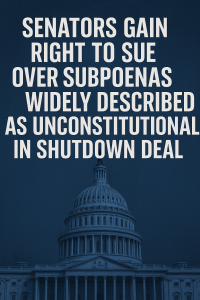
Senators can now sue the federal government for up to $500,000 per violation after revelations of unconstitutional DOJ subpoenas tied to the January 6 investigation.
By Jersey Joe | Host of Reaver of Common Sense on SHR Media
Recently, a significant legal battle has emerged as several senators sue over unconstitutional subpoenas, challenging their validity and seeking to uphold constitutional rights.
The government may have reopened, but Washington’s latest spending package hides a legal bombshell that has stunned both parties and constitutional lawyers across the country. Buried deep inside the hundreds of pages of budget text is a provision granting U.S. senators the right to sue the federal government for at least $500,000 per violation if their phone or office records were accessed without notification. The measure directly responds to subpoenas widely described as unconstitutional and in violation of Senate privilege.
According to Reuters, the clause was tucked into the legislative branch appropriations section of the massive spending bill, the same legislation both chambers hurried through to end the 40-day shutdown. The provision was not publicly debated or given a standalone vote, but its implications are enormous.
What the New Clause Does
The newly discovered section creates a private right of action for any senator “whose Senate data, or the data of their Senate office, was subpoenaed, accessed, or disclosed without lawful notice.” Each such violation carries a minimum penalty of $500,000 per violation, plus attorneys’ fees and damages.
In practical terms, it allows senators to hold the Department of Justice or any federal agency financially accountable for breaching the separation of powers by unlawfully obtaining legislative records or communications.
Multiple legal analysts confirm the measure has retroactive reach, meaning it applies to prior instances, specifically to cases tied to the January 6 phone-record subpoenas that targeted several Republican senators including Lindsey Graham and Marsha Blackburn. Those subpoenas, issued during Special Counsel Jack Smith’s investigation, reportedly bypassed normal notification procedures and raised significant constitutional concerns.
Why This Matters
The subpoenas may not have been adjudicated illegal in court, but they were widely criticized as a serious breach of the Speech and Debate Clause of the U.S. Constitution, a clause that shields members of Congress from executive-branch intrusion into legislative activities. The clause exists to prevent the executive from using investigations or prosecutions to intimidate lawmakers or gain access to privileged congressional communications.
By seizing Senate phone metadata without notice, the Department of Justice arguably overstepped its authority and violated long-standing constitutional boundaries between branches of government.
This new provision, while controversial, is being described by constitutional scholars as an attempt to restore that balance and ensure future members of Congress, regardless of party, are not subjected to similar breaches of legislative privilege.
The Background: DOJ Overreach and the January 6 Investigation
During the height of the January 6 investigations, federal prosecutors under Special Counsel Jack Smith issued sweeping subpoenas for phone records, emails, and communications data from multiple sitting senators. These included Republicans who had questioned the 2020 election certification or communicated with Trump administration officials during the post-election period.
Critics inside the legal community called those subpoenas “unprecedented” and “reckless,” noting that they extended beyond the scope of criminal inquiry and into constitutionally protected legislative work. Some subpoenas reportedly included metadata from official Senate phones and internal communications, a direct challenge to congressional privilege.
At the time, senators objected publicly but lacked an enforcement mechanism to fight back. The new spending bill changes that by creating a statutory right to sue the federal government for damages when those privileges are violated.
Democrats and Republicans See It Differently
The discovery of this clause has divided reaction along partisan lines. Some Democrats argue the measure was inserted without full debate and amounts to a political favor for the senators targeted by the earlier investigation.
Republicans defend the provision as a necessary correction to a constitutional violation, emphasizing that protecting legislative independence is not about shielding misconduct but about reaffirming that no branch of government may lawfully intrude upon another.
Sen. Marsha Blackburn of Tennessee stated that “the DOJ’s secret subpoenas were an outrageous abuse of power. Every branch of government must operate within the bounds of the law. This provision ensures that those who overstepped are held accountable.”
Even moderate Democrats privately acknowledged concerns over how the subpoenas were handled. One Senate aide told Reuters that “the Justice Department crossed a bright constitutional line, and no one wants to see that happen again.”
A Constitutional Reckoning
Legal scholars note that while this new clause may appear politically charged, it underscores a serious constitutional principle, the independence of the legislative branch from executive overreach.
The Speech and Debate Clause in Article I, Section 6 was written to prevent presidents, prosecutors, or law enforcement from using their power to intimidate or compromise the work of Congress. By issuing subpoenas to sitting senators without proper notice, the Justice Department, critics say, undermined that safeguard.
Constitutional attorney John Shu explained to Reuters, “The founders designed these protections to ensure Congress could operate without fear or intimidation. If executive agencies ignore that, it is not only improper, it is dangerous to the Republic.”
Accountability Has a Price Tag
Critics on the left have described the $500,000 threshold as excessive. Supporters counter that the figure reflects the gravity of constitutional harm and acts as a deterrent to future violations. The intent, they argue, is not to enrich senators but to establish real consequences for federal agencies that disregard constitutional limits.
Without meaningful penalties, executive overreach could continue unchecked. A financial deterrent ensures that agencies respect the independence of Congress.
One former Justice Department official told Reuters anonymously, “The fact this had to be codified shows how far trust has eroded. Agencies once respected boundaries, now Congress has to enforce them through litigation.”
Democrats Voted for It, Whether They Knew It or Not
While Democrats now express outrage, the record shows most voted for the broader spending bill. Whether they understood this clause was included is unclear. Several lawmakers have admitted privately they were unaware of its existence when they cast their votes to end the shutdown.
That revelation reinforces the long-standing conservative argument that massive omnibus bills are vehicles for hidden provisions, passed unread and unexamined until it is too late.
Both parties have contributed to that problem, but this time the secrecy exposed a major constitutional lapse that forced Congress to legislate its own legal protection.
Transparency Still Lacking
Even as the government reopens, key questions remain. Who authorized the subpoenas? What data was seized? And how deeply did the Justice Department’s requests penetrate Senate communications?
So far, the administration has not commented. The Department of Justice has declined to confirm whether internal reviews are underway. Congressional oversight committees have yet to announce hearings to determine how many subpoenas were issued and under what authority.
The silence only strengthens calls for transparency and for some, vindicates the need for the new legal remedy now written into law.
The Real Issue: Protecting the Separation of Powers
This controversy reaches beyond party lines. The separation of powers exists to prevent any branch from dominating another. When the executive crosses into legislative territory, it threatens the very structure of the Republic.
The new clause, while controversial, reasserts that Congress is not subordinate to the executive branch. It sends a message that oversight cuts both ways and that constitutional limits still matter, even in the era of politicized investigations.
Editorial Closure
The Justice Department’s decision to subpoena Senate phone records without notice set a dangerous precedent that blurred the line between investigation and intimidation. Whether one supports or opposes the new legal provision, it reflects a long-overdue acknowledgment that congressional privilege is not optional.
Democrats may regret voting for a bill they did not fully read, but the outcome could restore critical constitutional balance. Congress did not just reopen the government with this legislation, it reopened the debate over how far the executive branch can reach before the rule of law pushes back.
In that sense, accountability, even delayed, is worth every penny.
Sources
- Reuters: Deal to end shutdown includes right for senators to seek $500,000 per violation
- Bloomberg Law: Shutdown deal would let senators sue over Jack Smith searches
- CBS News: Provision allows senators to sue for up to $500,000 per violation
Read more on SHR Media
- Senate takes first step toward ending the government shutdown
- Gavin Newsom shames Democrats for capitulation on shutdown
- Jeffries defends Schumer after shutdown deal
By Jersey Joe | Host of Reaver of Common Sense on SHR Media
(All information verified through public records, congressional statements, and reporting from Reuters and Politico.)
Don’t forget to follow Jersey Joe on X or SHR Media for updates and live show announcements.
© 2025 Jersey Joe | SHR Media. All rights reserved.
Support Independent Media – Keep Common Sense Alive
Enjoyed this article? At SHR Media we are fully independent and refuse to hide truth behind a paywall. Every piece of our journalism is built for you and by you.
If you believe in honest reporting, free speech, and holding those in power accountable, your support matters.
👉 Donate Today and Help Keep Independent Journalism Alive
About the Author

Discover more from SHR Media
Subscribe to get the latest posts sent to your email.