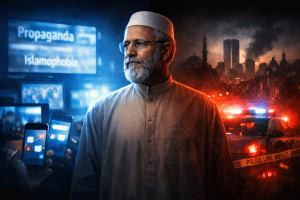
A symbolic illustration representing the debate over whether Islam’s global reputation was shaped by propaganda or by decades of jihadist attacks since 9/11.
A Claim That Raises a Bigger Question
The Yusuf Islam propaganda claim has sparked debate about how Islam’s reputation has been shaped in the modern world.
Musician Yusuf Islam, formerly known as Cat Stevens, recently lamented that Islam has been the target of what he called a monstrous propaganda machine.
Stevens argued that a coordinated effort distorted Islam in the public eye and shaped negative perceptions of the religion. He suggested he was fortunate to discover Islam before this machine began influencing global opinion.
That claim raises an interesting question.
Are negative perceptions of Islam primarily the result of propaganda?
Or have they been shaped by the events of the past two decades?
The answer is glaringly obvious to anyone who has been paying attention.
The Shadow of September 11
The modern debate over Islam’s global image did not begin with media coverage or political commentary. It began with the September 11 attacks.
On that day in 2001, terrorists affiliated with Al-Qaeda hijacked four commercial airliners and killed nearly 3,000 people in coordinated attacks against the United States.
The scale and brutality of the attack reshaped international politics overnight. Governments launched wars against terrorist networks. Security policies changed worldwide. News coverage of Islamist extremism intensified.
For many Americans and Europeans, and Westerners in general, September 11 was a pivotal moment. It was the point at which the words jihadist terrorism and Islam first became linked in the public consciousness.
A public relations campaign did not create that connection. A catastrophic act of violence committed in the name of religion created it.

Decades of Jihadist Attacks
The attacks did not begin on September 11 and they certainly did not end there.
Research compiled by the Global Terrorism Database and the annual Global Terrorism Index reveals thousands of terrorist incidents worldwide over the past two decades.
Groups such as the following have carried out many of the deadliest attacks:
These groups claim religious justification for their violence. Apologists dispute that, despite what the Qur’an teaches about how Muslims are required to conduct themselves.
Still, the attacks themselves are real and widely documented.
News outlets around the world broadcast events such as the 2015 Paris attacks, the 2016 Brussels bombings, and the 2019 Sri Lanka Easter bombings.
Each one reinforced the association between extremist violence and Islamist ideology in the public consciousness.
A more recent development is generational distance. Many younger Americans did not live through the September 11 attacks. For them, the defining moment that shaped earlier public perceptions of Islamist extremism is something they only know from yearly memorials.
That gap in lived experience has helped fuel a growing belief among some younger observers that concerns about Islamist violence are largely the product of political propaganda amplified by older generations.
That context matters when discussing how Islam is perceived globally.
Stevens’ Own Controversial Past
Stevens is not a neutral observer in this debate.
His own public statements have been controversial for decades.
During the Salman Rushdie fatwa controversy, Yusuf Islam (Stevens) appeared in media interviews discussing Islamic law after Iran’s government issued a death sentence against author Salman Rushdie.
At the time, reporters asked Stevens point-blank whether he believed Rushdie deserved to die. He responded, “Yes, yes.” The interviewer then asked whether he had a duty to carry out the sentence, and Stevens said he would if Islamic authorities ordered it. He said that under Islamic law, someone who insulted the Prophet Muhammad could face execution.
The comments caused a global backlash and have followed him ever since.
Stevens later said he was describing religious law rather than advocating violence. Video evidence suggests otherwise, and critics remain unconvinced. The controversy remains part of his public record.
That history is why his comments about propaganda attract scrutiny today.
A Distinction Without A Difference
Apologists say that Islam itself should not be judged by the actions of so-called extremists.
Around the world, more than a billion people claim to be peaceful followers of Islam. Based on the teachings of the Qur’an, that claim is difficult to reconcile with what Islam requires of believers.
That distinction is critical to those who believe Islam is a “religion of peace.”
But the jihadists exist. The attacks are documented. Their rhetoric openly claims religious justification.
That reality complicates the argument that public concern about Islamist violence is primarily the result of propaganda.
The Real Conversation
Stevens is correct about one thing.
Media narratives do shape public perception. Governments shape them as well. Propaganda exists in every geopolitical conflict.
But the modern debate about Islam did not begin with propaganda.
It began with events like September 11 and the long series of jihadist attacks that followed.
Until that reality is acknowledged, the conversation around Islam’s reputation will continue to bounce between indifference, denial, and the historical record.
“Big-E”
Earl “Big E” Jackson is the host of The Mission Ready Men Briefing on the SHR Media network. The opinions expressed in this article are his own and reflect a commitment to Biblical principles, primary source research and constitutional literacy.
Sources
About the Author

Discover more from SHR Media
Subscribe to get the latest posts sent to your email.