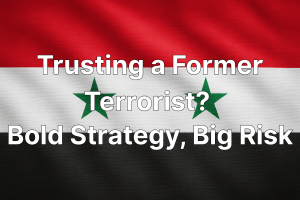
Graphic used for Mission Ready Men article on the risks of relying on a former terrorist.
It seems we’ve reached the point in foreign policy where the United States and Israel are expected to take “former terrorist” as a résumé upgrade. Ahmed al-Sharaa, Syria’s new leader who made a name for himself with jihadist groups, is now the face of “pragmatism” in Washington. So much so that he’s invited to the White House, while U.S. diplomats talk about “stability,” “reform,” and “regional balance.”
To which any rational observer should ask: Are we serious right now?
The makeover: “From extremist to statesman”
Al-Sharaa rose through the ranks of jihadist networks once linked to al-Qaida’s Syrian affiliate, the al-Nusra Front. Now he’s being rebranded as a reformer intent on mending fences with the West and easing tensions with Israel. Reuters reports that Washington has even asked the U.N. to lift sanctions on Syria’s leadership ahead of his visit.
So the man who once waged jihad now has an invitation to the table in D.C. because — why? He says the right things? That’s not diplomacy — that’s public relations and sophistry dressed up as realism.
“Few leaders once labeled as terrorists by the U.S. visit the White House — yet here we are.”
The problem with trusting “pragmatic” radicals
Credibility matters.
Legitimizing someone like al-Sharaa signals to every extremist watching that violence pays. Play the long game — something Islam specializes in — rebrand yourself, and you’ll be rewarded. That’s a dangerous precedent, one that tells our allies we’ll do business with anyone if the optics are good enough.
Israel’s security is the canary in this coal mine.
Every missile that launches from Syrian soil into the Golan Heights is a reminder of what “peace partners” can turn into when the cameras are gone. The regime that still hosts Iranian proxies and winks at Hezbollah is suddenly expected to “cooperate”? That’s wishful thinking bordering on delusional optimism.
The realpolitik argument — and why it’s wrong
The Council on Foreign Relations recently suggested a U.S.–Syria summit could help mend “a fractured Syria.” Middle East Eye framed Ahmed al-Sharaa’s trip as an opportunity to ease sanctions and boost Syria’s global standing. Fine. But realpolitik doesn’t mean amnesia.
Realism means understanding the terrain as it is, not pretending that men who built their careers on Islamic extremism will suddenly become Jeffersonian democrats once they get a state dinner.
The argument that a rehabilitated Syria could serve as a counterweight to Iran and stabilize the region is a pipe dream. History tells us otherwise — Saddam in the ’80s, Gaddafi in the 2000s, Bashir in Sudan, even the Taliban in Afghanistan. Each time, Washington convinced itself that a “reformed strongman” was better than no strongman at all. And each time, that optimism blew up — sometimes literally.
Israel’s position: trust, but you’d better verify
For Israel, this kind of “diplomatic reboot” isn’t just a gamble — it’s a threat vector. The country already faces war on multiple fronts: Hezbollah in the north, Hamas in the south, and Iran lurking everywhere else. Now it’s supposed to pretend that Damascus is a trustworthy neighbor because the State Department wants a photo op?
Israel’s doctrine of deterrence depends on predictability — the clear message that aggression has consequences. Cozying up to al-Sharaa muddies that message. It gives legitimacy to an unstable regime that still owes much of its survival to Russian airpower and Iranian money.
Israel should double down on vigilance — not smile for the cameras while a former jihadi walks through the Rose Garden.
America’s moral whiplash
How does this reflect on us? For two decades, American soldiers fought and died in the Middle East under the banner of defeating terrorism. Thousands of Gold Star families were told their sacrifice helped prevent extremists from gaining power. Now Washington wants to shake hands with one?
It’s a slap in the face to every service member who took that fight seriously. And it undermines the principle that America stands for — that freedom and terrorism can’t coexist under the same flag, even for “strategic reasons.”
What the U.S. and Israel should do
Keep the pressure on. Sanctions shouldn’t be lifted because someone gave a nice speech. Require tangible steps — human-rights monitoring, expulsion of Iranian forces, and verifiable cooperation with Israel.
Maintain deterrence. Israel’s best defense remains strength. The IDF and Mossad know the region better than Foggy Bottom ever will.
Use leverage, not flattery. Engagement works only when backed by consequences. Carrots without sticks breed complacency and contempt, not cooperation.
Be honest with the American people. Stop pretending this is “peace.” Call it what it is — a risky experiment built on untested promises.
The bottom line
This isn’t diplomacy — it’s wishful thinking disguised as strategy. The president wants to prove he can still manage the Middle East chessboard, even if that means shaking hands with the same players who once planned and carried out terror attacks.
But alliances built on fantasy can’t last. A “pragmatic” terrorist is still a terrorist until proven otherwise — and so far, the proof is nonexistent.
If Syria wants to rejoin civilized society, fine. But trust is earned, not granted with a visa stamp. The U.S. and Israel should hold fast, keep their shields up, and remember: when you lie down with radicals like Ahmed al-Sharaa, don’t be surprised when you wake up missing your freedom — or dead.
Earl “Big E” Jackson is the host of The Mission Ready Men Briefing, a Christian conservative commentary series where conviction meets culture.
Watch full episodes on Rumble and YouTube, and find daily updates on X (formerly Twitter).
For patriotic apparel and gear, visit MissionReadyMen.com — Apparel for the Patriotic Man of God.
About the Author

Discover more from SHR Media
Subscribe to get the latest posts sent to your email.