
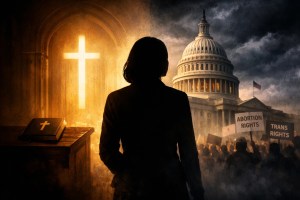
A dramatic illustration depicting the growing tension between traditional Christian beliefs and the Democratic Party’s positions on abortion and gender ideology.
By Big-E
When Faith Collides With Party Orthodoxy
State Rep. Karen Whitsett, a Democrat from Michigan, just said out loud what many of us already knew, but most politicians avoid saying altogether.
Her Christian faith no longer has a place in the modern Democratic Party.
State Rep. Karen Whitsett announced she will not seek reelection. The decision was not about strategy or polling. It was not fatigue or a desire to spend more time with family.
It was faith.
Whitsett said she cannot reconcile her Christian faith with the party’s positions on abortion and gender ideology. She now plans to devote more of her life to Jesus Christ.
That admission says far more about the direction of American politics than one retirement announcement.
Because this is not a one-off story. It is the culmination of a trend that has been developing for years.
The Disappearing Pro-Life Democrat
There was a time when the Democratic Party made room for religious dissent.
Those days are over.
Fifteen years ago, many Democrats in Congress identified as pro-life. Some grounded their views in Catholic teaching. Others cited evangelical beliefs.
They were not fringe figures. They were mainstream Democrats.
One of the most visible was Bart Stupak.
Stupak led a group of pro-life Democrats during the fight over Obamacare. He pushed an amendment meant to block taxpayer funding for abortion.
The backlash was immediate. Progressive activists revolted. Party leadership applied pressure.
Soon after the battle, Stupak announced he would not run for reelection.
The message was clear.
There was less and less room in the party for lawmakers who allowed their Christian beliefs to shape their position on abortion or any other issue.

The Purge Accelerates
By the late 2010s, the purge was in full swing. They weren’t hiding it any longer.
Illinois congressman Dan Lipinski was one of the last openly pro-life Democrats in the House.
Lipinski cited his Catholic faith as the basis for his stance. That put a target on his back.
Progressive groups poured money into a primary challenge. National abortion rights organizations mobilized against him.
In 2020, Lipinski lost.
His defeat carried a clear signal.
A Democrat could either oppose abortion or remain in the party. Doing both had become politically impossible.
Faith Is Now the Problem
This is the context surrounding Whitsett’s decision.
The conflict she described did not unfold overnight.
It developed as the party moved from tolerating abortion to treating it as a defining moral cause. The shift did not stop there. Gender ideology followed close behind.
Opposition to either position now leads to accusations of bigotry or extremism.
For politicians who take Scripture seriously, the pressure is obvious.
Choose the party line or choose your faith.
Karen Whitsett chose her faith. That choice ended her political career.
A Political Realignment in Plain Sight
The irony is impossible to ignore.
The Democratic Party once portrayed itself as a defender of the Christian Faith. The political home for working-class, church-going voters.
Today, a state lawmaker says she must leave politics because the party’s moral positions conflict with Christianity.
I have said this many times on my show and elsewhere. The change did not happen quietly or in a vacuum.
It happened through primary challenges. Platform changes. Activist pressure. Cultural messaging that reframed traditional Christian belief as intolerance.
Whitsett simply said the quiet part out loud.
Her departure raises a larger question.
If a Christian lawmaker cannot reconcile Biblical teaching with the party’s current agenda, how many ordinary voters are facing the same dilemma?
The answer may determine far more than the future of one Michigan seat.
“Big-E”
Earl “Big E” Jackson is the host of The Mission Ready Men Briefing on the SHR Media network. The opinions expressed in this article are his own and reflect a commitment to Biblical principles, primary source research and constitutional literacy.
Sources
About the Author

Discover more from SHR Media
Subscribe to get the latest posts sent to your email.