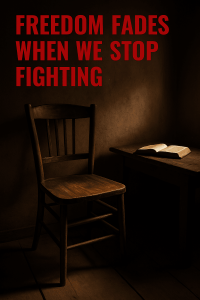
A symbolic editorial image representing comfort replacing conviction — used for Big E’s op-ed “From Chains to Comfort: How Freedom Fades When We Stop Fighting.”
By Big E | Mission Ready Men | SHR Media
I recently did a segment on the show about a Howard University journalism professor who told white “allies” to channel abolitionist John Brown if they truly wanted to oppose racism. If you’re familiar with Brown’s history, you can see how that could be taken as a call for violence. If not, here’s a brief refresher.
John Brown was a zealous abolitionist who believed—rightly—that slavery was an evil institution that had to be destroyed. His methods, however, were merciless. He saw himself as a biblical avenger—an instrument of God to punish America for slavery. He believed that dramatic, even brutal, acts of violence would shock the conscience of the nation and spark a revolt among both enslaved people and sympathetic whites.
In 1856, he and his followers struck at Pottawatomie Creek during the “Bleeding Kansas” conflict, killing five pro-slavery settlers. Three years later, he led a raid on the federal arsenal at Harpers Ferry, hoping to ignite a massive slave uprising. The rebellion never came. Brown was captured, convicted of treason, murder, and inciting a slave insurrection, and hanged in 1859.
Brown died believing that freedom required sacrifice. Yet the insurrection he hoped to inspire never came—and that failure invites a harder question today. The people he sought to liberate did eventually gain freedom, but generations later many of their descendants live under a different kind of bondage: one not enforced by chains or overseers, but by comfort, dependency, and despair of our own making. It’s psychological servitude—a quiet surrender that trades responsibility for relief.

The Fragility of Freedom
Patrick Henry once thundered, “Is life so dear, or peace so sweet, as to be purchased at the price of chains and slavery? Forbid it, Almighty God! I know not what course others may take; but as for me, give me liberty or give me death!”
More than a century later, another great orator would echo that same spirit when he warned:
“Freedom is never more than one generation away from extinction.
We didn’t pass it to our children in the bloodstream.
It must be fought for, protected, and handed on for them to do the same,
or one day we will spend our sunset years telling our children and our children’s children what it was once like in the United States where men were free.”
— Ronald Reagan
Reagan’s warning echoes throughout communities and households and looms large in today’s political climate. Every generation must decide whether freedom is something to defend or something to delegate—and false security has become the quiet thief of conviction.
The Descent into Dependence
Freedom is a fragile proposition. It doesn’t maintain itself. Once the battle is won, it must be tended, guarded, and lived out—or it begins to rot from within. The generation that breaks its chains is rarely the same generation that learns how to live without them. That was the tragedy that followed emancipation.
When the Civil War ended, millions of freedmen stepped into the sunlight of liberty with no land, no education, and no protection. The promise of “forty acres and a mule” vanished in the aftermath of Lincoln’s assassination. What replaced it was a system designed to keep them in place—sharecropping, debt peonage, and Black Codes that criminalized unemployment and vagrancy. Many went back to the very plantations they had been freed from—not because they missed bondage, but because the structure that had been put in place robbed them of every resource that would have made freedom sustainable.
It Was Survival
That was not surrender or submission; it was survival. And even in that suffocating environment, they built. They built churches, schools, businesses, and entire towns. Families thrived. Faith blossomed. In less than a generation, Black Americans were producing authors, entrepreneurs, inventors, and pastors. The foundation was faith, family, and hard work. This led to a strength and resilience that no overseer could suppress.
“The quiet acceptance of control masquerading as liberty.”
But as the decades rolled on, something shifted. The old overseers disappeared, but new ones took their place—bureaucrats with pens instead of whips. Dependency was rebranded as compassion. The welfare state promised to provide what community once did. The result was slow but devastating: the rejection of personal responsibility, the destruction of the black family, and the quiet acceptance of control masquerading as liberty.
That’s how liberty dies—not with chains and shackles, but with subsidies and handouts. It dies when a people begin to mistake provision for comfort and security for freedom. It dies when courage is replaced by convenience.
What Choice Did They have?
Our ancestors didn’t have much of a choice; we do. They were forced back to the plantation by law and poverty. We’re strutting back voluntarily, and under the delusion that we own the place—happily accepting each government handout, each political promise, and each cultural compromise. When you compromise once, it’s that much easier to accept the next one.
Reagan warned that freedom must be fought for, protected, and handed down, not merely inherited. The problem isn’t that someone stole it from us—it’s that we stopped fighting to keep it. Freedom demands maintenance: spiritual, moral, and cultural. And the first step to keeping it is recognizing how cheaply and easily we’ve sold it.
“That’s how liberty dies—not with chains and shackles, but with subsidies and handouts.”
We traded the blood-bought liberty of our ancestors for a counterfeit version—managed freedom. Freedom with stipulations. Freedom that offends no one, costs nothing, and demands nothing. It’s an imitation that keeps those who fall for it comfortable but powerless.
The irony is stark: a man like John Brown died trying to awaken a nation to the evil of slavery. Today, we lull ourselves back to sleep under a softer oppression—not one of chains, but of choices. We’re not being driven by a master; we’re being seduced by ease. And as history has shown, that’s a far more effective prison.
Reclaiming Freedom
The path back isn’t complicated, but it is costly. Real freedom has always carried a price tag—responsibility, courage, and discipline. You don’t get to keep it by complaining, outsourcing it to politicians, stealing it from those who earned it, or begging for permission from the same system that profits from your submission.
Our forefathers understood that. They didn’t wait for a government program or a cultural nod of approval; they built what they needed. The forefathers built families that prayed together, communities that stood together, and churches that told the truth even when it hurt. They understood that liberty begins in the soul with service to our Lord and Savior, long before it shows up in the laws of man.
“You can’t be free and faithless.”
That’s what we’ve discarded—the conviction that freedom isn’t given, it’s kept. You can’t be free and lazy at the same time. You can’t be free and dependent on men who despise the values that made you free in the first place.
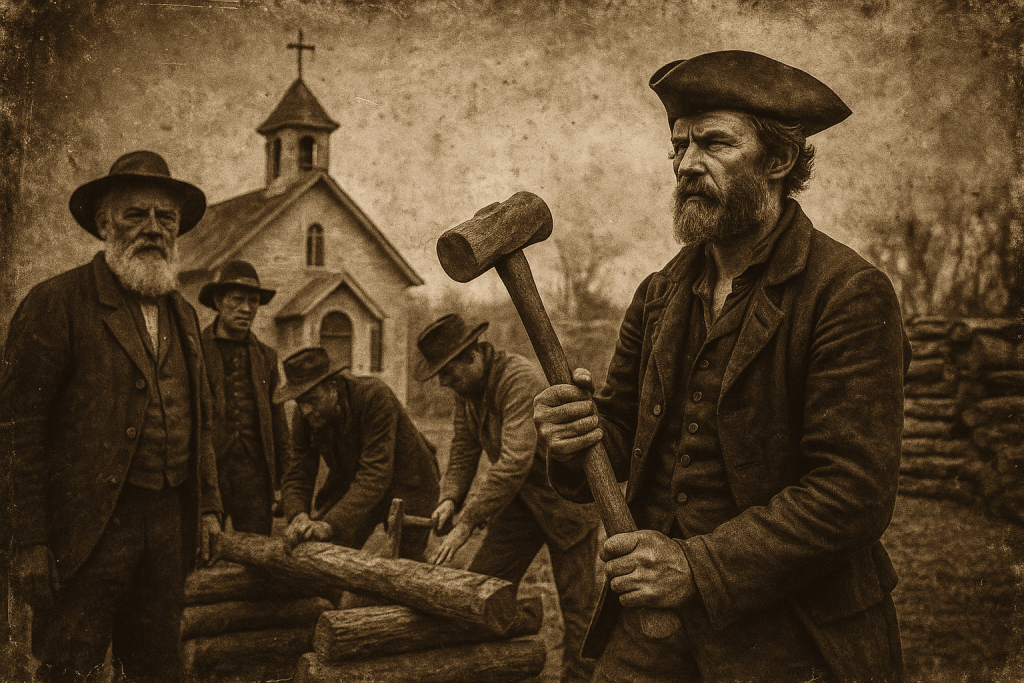
The fight now isn’t on a battlefield or at an armory—it’s in our homes, our pulpits, our schools, and our own hearts. The weapons are faith, truth, and grit. We don’t need another John Brown swinging a sword; we need men and women willing to swing a hammer, build something, and teach their children how to do the same.
We Were Warned
Reagan warned that freedom is lost when it’s no longer defended. In that case, we won’t be passing on liberty—we’ll be passing on regret, telling our children what freedom used to be. And when that day comes, it won’t be because someone overpowered us; it will be because we got complacent.
Freedom has always belonged to those willing to defend it, not just with words, but with work. Our ancestors proved it in the fields. The question is whether we’ll prove it now—in our families, our faith, and our future.
Editorial Closing
About the Author:
Big E is the host of Mission Ready Men, airing Tuesdays and Thursdays at 12 PM EST on the SHR Media Network.
Visit his official site: MissionReadyMen.com
Follow Mission Ready Men on:
(SHR Media, 2025. All Rights Reserved.)
About the Author

Discover more from SHR Media
Subscribe to get the latest posts sent to your email.