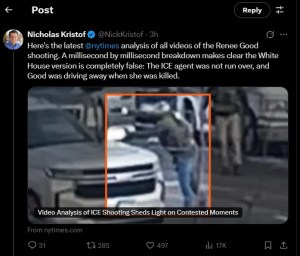
Nicholas Kristof shares a New York Times “video analysis” of the Renee Good shooting, using a still image that appears to show a different vehicle than the one central to the dispute.
January 15, 2026
A New York Times columnist, Nicholas Kristof, promoted an NYT “video analysis” of the Renee Good shooting and told readers it proves the White House version is “completely false.” His post claims the ICE officer was not run over and that Good was driving away when she was killed.
That is a big claim. If you are going to declare one side “completely false,” you better show your work in a way regular people can verify.
But the way this was promoted does the opposite.
The thumbnail problem no one is supposed to notice
The preview image used in Kristof’s post is misleading on its face.
In the image, the ICE officer is standing next to a silver SUV with a visible gap between the officer and the vehicle. That visual strongly suggests, “See, he was not hit.”
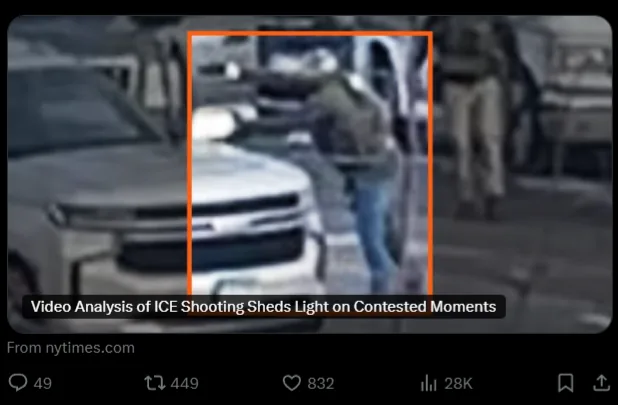
There is only one problem.
Video showing the incident, that is public,identify the vehicle Renee Good was driving as a Maroon Honda Pilot, and Reuters describes her vehicle as a maroon SUV. In other words, the silver SUV featured in the promo image is not the vehicle tied to the key disputed moment.
So why use a still shot next to a different vehicle to sell a “millisecond by millisecond” breakdown? The seemingly obvious answer is to mislead people on social media.
If the NYT has a frame by frame analysis, it could have used an actual still from the real vehicle during the real moment. Instead, the promo image invites people to reach a conclusion without seeing the relevant evidence.
The Video Breakdown
Here is the video that is widely spread around the internet of the incident. As you can see in this clip, that is rewinded several times, not only is the vehicle involved a Maroon Honda Pilot, but it strikes the DHS Officer.
Why this looks like narrative by thumbnail
This is the play:
- Make a strong claim.
- Use a compelling image that “proves” it at a glance.
- Put the full argument behind a subscriber box that most won’t sign up for.
- Let activists and drive by reposts do the rest.

People who already agree will repost the image, add one line, and move on. They will not ask why the image does not match the vehicle central to the dispute. Most will not ask what the underlying analysis actually shows. They will not even notice the framing is misleading.
That is how you launder a conclusion into the public bloodstream without having to win an honest argument.
A quick reality check on NYT credibility
This is not a claim about motive. It is a reminder of documented episodes where the New York Times has issued major walkbacks, faced findings of serious falsehoods, or taken heavy criticism for major editorial choices.
- Iraq WMD coverage: The NYT published an editors note in 2004 acknowledging its Iraq coverage relied too heavily on flawed sources and insufficient skepticism.
- Jayson Blair scandal: The NYT was rocked by a major fabrication and plagiarism scandal that led to a sweeping internal review and top level resignations.
- Caliphate podcast: The NYT said parts of its Caliphate podcast did not meet its standards after an internal investigation and it returned a Peabody Award tied to the series.
- 1619 Project disputes: Prominent historians publicly challenged key framing and claims and the project has remained heavily contested in scholarly and media circles.
- Hunter Biden laptop timeline: Major outlets, including the NYT, treated the story with extreme caution in 2020, then later reporting acknowledged emails from a cache of files that appeared to come from the laptop and that some material had been authenticated. Independent forensic work by other outlets also found some authentic emails while noting serious chain of custody problems.
The point is not that the NYT is always wrong. The point is that you should not grant it automatic authority, especially when it is selling a conclusion with a promo image that does not match the core factual dispute.
Bottom line
If you are going to call the White House account “completely false,” you do not get to use a convenient still shot next to the wrong vehicle as your proof.
That is not analysis. That is a marketing ploy.
And when a narrative depends on most people never clicking past a paywall or signing up for the website, the thumbnail becomes the story.
Written by SHR Media Staff
This article is a collaborative effort by the SHR Media Staff. Our content reflects a collective commitment to primary source research and constitutional literacy. Explore our cornerstone articles where we prioritize factual source documents over partisan narratives.
Sources:
Sources
- Nicholas Kristof post on X sharing NYT video analysis
- Nicholas Kristof post on Threads sharing NYT video analysis
- ABC News: minute by minute timeline and metadata analysis of the shooting
- Reuters: reconstruction and analysis of available visuals
- FactCheck.org: how different sides interpret the same video
- The Guardian: NYT mea culpa on Iraq WMD coverage
- PBS NewsHour: overview of NYT WMD coverage issues
- PBS NewsHour: NYT says Caliphate podcast did not meet standards
- Axios: NYT returns Peabody tied to Caliphate after falsehood findings
- The Guardian: Jayson Blair scandal and fallout
- American Historical Review: 1619 Project forum and scholarly critiques
- The New Yorker: overview of the 1619 Project debate
- Washington Post: forensic review of data said to be from the laptop
- Vox: timeline and what was later reported about laptop emails
About the Author

Discover more from SHR Media
Subscribe to get the latest posts sent to your email.