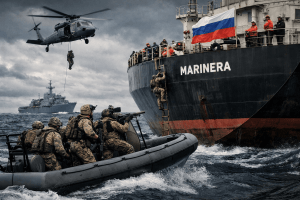
US military and Coast Guard vessels intercept a sanctioned Russian-flagged oil tanker in the North Atlantic during a high-risk maritime operation
By SHR Media
U.S. forces are trying to board a Russian-flagged oil tanker in the North Atlantic. This is part of an enforcement action tied to international sanctions. This information comes from sources familiar with the operation.
The tanker was identified in reporting as a vessel formerly linked to sanctioned oil transport activity. It is alleged to have been involved in moving oil connected to regimes under U.S. sanctions. American officials reportedly believe the ship has engaged in sanctions evasion, prompting the attempted interdiction in international waters.
According to Fox News, U.S. military and Coast Guard assets are involved in the operation. The effort is said to be based on an existing U.S. seizure authorization tied to prior violations, not a new declaration of hostilities. Officials cited in the report emphasized that the mission is focused on sanctions enforcement rather than escalation with Russia.
A High-Risk Maritime Standoff
The situation is complicated by the vessel’s Russian flag status. Under international maritime law, ships on the high seas generally fall under the jurisdiction of their flag state. U.S. officials reportedly argue that the tanker’s alleged sanction-busting activity creates a legal basis for boarding despite the Russian registry.
Russian officials, according to international reporting, have condemned the attempted boarding and warned against interference with Russian-flagged vessels. Moscow maintains that the tanker is operating lawfully and has framed the U.S. action as a provocation.
Reports of Russian naval assets operating in the broader region have emerged. Defense analysts are concerned about the potential for miscalculation or confrontation. No shots have been fired, and no injuries have been reported as of this writing.
Strategic and Political Implications
The attempted boarding highlights growing friction over sanctions enforcement and maritime authority at a time of heightened global tension. The use of energy shipments to bypass sanctions has become a central tactic for sanctioned regimes, forcing the U.S. and its allies to choose between aggressive enforcement and diplomatic restraint.
Critics argue that these kinds of operations risk escalating already fragile relations with nuclear-armed adversaries. Supporters counter that failing to enforce sanctions renders them meaningless and rewards illicit behavior.
At this stage, details stay limited, and officials have not publicly disclosed the full scope or outcome of the operation.
SHR Media will continue to follow this story and report confirmed developments as they emerge.
Don’t forget to follow Jersey Joe on X or SHR Media for updates and live show announcements.
© 2025 Jersey Joe | SHR Media. All rights reserved.
Support Independent Media – Keep Common Sense Alive
Enjoyed this article? At SHR Media we are fully independent and refuse to hide truth behind a paywall. Every piece of our journalism is built for you and by you.
If you believe in honest reporting, free speech, and holding those in power accountable, your support matters. Even the smallest contribution helps us fight censorship and shine a light on the stories the mainstream media ignores.
👉 Donate Today and Help Keep Independent Journalism Alive
About the Author

Discover more from SHR Media
Subscribe to get the latest posts sent to your email.