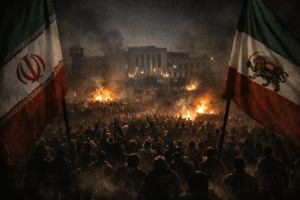
Iran protesters gather at night as unrest spreads and the regime signals force
Iran’s collapsing currency and brutal inflation are real. People cannot buy basics, wages do not keep up, and a system built on corruption makes sure the pain lands on ordinary families first.
But reducing this uprising to economics misses the point. This is also a population that has lived for decades under a totalitarian religious regime that uses fear as policy, prison as persuasion, and violence as crowd control. When people hit the streets in Iran, they are not just protesting prices. They are testing the regime’s grip.
Update: What is being reported right now
Reports from major outlets and rights groups describe protests that began around late December in Tehran’s bazaar and then spread across much of the country.
What is being reported as of today
- Protests have spread well beyond Tehran, with reports of unrest across most provinces.
- Reported death tolls vary by source, with rights groups and media giving different totals.
- Arrest numbers are also reported in the thousands, with detentions continuing as security forces move city to city.
- Security forces have used tear gas in Tehran’s Grand Bazaar area, and there are widely circulated reports of aggressive raids and beatings, including a reported hospital raid in the west.
Iran’s government is publicly promising economic fixes and warning that it will not tolerate unrest. That is a familiar pattern. Offer small concessions, blame outsiders, then bring out the batons.
Inflation is real, but it is not the whole story
A collapsing rial and runaway inflation create the conditions for mass unrest. When a family cannot afford food, heat, medicine and rent, the math becomes political.
But Iran has endured economic punishment before. Sanctions, mismanagement and currency shocks are not new. What feels different in this moment is how quickly economic anger is turning into direct hostility toward the ruling system itself, not just the cabinet of the day.
A regime that knows only force
The Islamic Revolutionary Guard Corps and associated security forces have a long, well documented history of crushing dissent. The playbook is predictable: mass arrests, intimidation, information control, then lethal force when fear is not enough.
Iran’s record includes major crackdowns in 2019 and during the 2022 protests after Mahsa Amini’s death, with human rights organizations documenting unlawful killings, arbitrary detentions and internet shutdowns used to hide the scale of violence. That history matters because it shapes what protesters expect now. Many Iranians believe the regime will escalate rather than negotiate.
Water crisis pressure is gasoline on the fire
Iran’s unrest is also happening against a backdrop of worsening water stress. Shortages are not just an inconvenience. They are survival level pressure that hits households, farms and industry at once. When basic services fail, public anger stops being abstract and becomes personal.
Water scarcity also widens unrest geographically. Inflation hits everywhere. A water crisis turns specific provinces into pressure cookers.
The regime is signaling strength with drills
While protests spread, Iranian state linked reporting and outside analysts say the security apparatus has also been running high visibility military and air defense activity. The message is not subtle. The regime wants protesters to feel watched, and it wants foreign capitals to think twice about taking advantage of the chaos.
That does not mean the drills prove confidence. Sometimes regimes posture most when they are nervous.
The shadow of the nuclear strikes
This uprising is unfolding just months after major strikes on Iranian nuclear related sites during the June 2025 Israel Iran conflict, followed by U.S. strikes later in that same period, according to multiple official and credible reports. That matters for two reasons.
First, it undercuts the regime’s narrative of total control and deterrence. Second, it raises the risk of miscalculation. A regime under internal pressure is more likely to lash out externally, and more likely to overreact to threats, real or perceived.
Reports that the Supreme Leader could flee
There are reports in international media claiming Iran’s Supreme Leader could have a contingency plan to flee to Russia if unrest overwhelms the security services. Iran has not confirmed any such plan, and these claims are inherently difficult to verify from outside a closed system.
Still, the fact that these reports are circulating tells you something important. Confidence is not high, rumors are filling the vacuum, and every absence from public view becomes a storyline.
Calls for outside strikes and support are growing
Some voices outside Iran are arguing for direct military action to support protesters or to hit regime security infrastructure. Others argue the opposite, warning that foreign strikes would let Tehran rebrand domestic dissent as foreign aggression and justify even harsher repression.
Inside Iran, many protesters appear focused on one immediate goal: keep momentum, keep streets and markets active, and overwhelm the regime’s ability to isolate one city at a time.
The hardest question: what happens if the government falls
Even critics of the regime admit a simple truth. There is no clear, universally accepted plan for a post regime Iran.
There are opposition figures, diaspora movements and regional groups with competing visions. There are also hard questions about the military, the IRGC, internal fragmentation and who controls what on day one after collapse. A vacuum is dangerous, and Tehran knows it. The regime sells fear of the unknown because it is one of its last working tools.
What to watch next
- Strikes that shut down markets, transport and key industries
- Whether protests consolidate around a clear national demand or remain decentralized
- Any sustained internet disruptions or communications blackouts
- Signs of fractures inside security forces or political elites
- Any external escalation that gives Tehran cover for a wider crackdown
Iran’s uprising is not just an economic story. It is a freedom story, a survival story and a regime violence story. Inflation may have lit the match, but decades of oppression built the pile of kindling.
Written by SHR Media staff, copyright 2026
Sources
- Reuters reporting on the latest death toll estimates, arrests and protest spread (January 6, 2026). Reuters
- Associated Press reporting on clashes at Tehran’s Grand Bazaar and reported fatalities and detentions (January 6, 2026). AP News
- The Guardian reporting on clashes, the Grand Bazaar sit in and reported crackdown incidents (January 6, 2026). The Guardian
- The Guardian reporting on economic concessions being weighed amid the unrest (January 5, 2026). The Guardian
- RFE RL Radio Farda reporting on eyewitness accounts and security force violence in western Iran. RadioFreeEurope/RadioLiberty
- Amnesty International on internet shutdowns and killings during the November 2019 crackdown. Amnesty International+2Amnesty International+2
- Reuters special report on the 2019 crackdown orders and the scale of violence. Reuters
- Human Rights Watch on lethal force and repression during the 2022 protest crackdown. Human Rights Watch+1
- U.N. Office of the High Commissioner for Human Rights experts statement condemning killings and the crackdown in 2022. OHCHR
- CSIS analysis using satellite imagery on Tehran’s accelerating water crisis. CSIS
- CTP ISW Iran Update on protests and reported IRGC missile and air defense activity. Institute for the Study of War+1
- Reuters on Iran missile drills reported by state media in late 2025. Reuters+1
- Reuters on Israel stating it targeted nuclear sites including Natanz and Arak in June 2025. Reuters
- IAEA statement on the situation in Iran and Natanz being impacted (June 13, 2025). IAEA
- UK House of Commons Library briefing on U.S. strikes on Iranian nuclear facilities and Iran’s response (June 2025). House of Commons Library
- Reporting on claims that Khamenei has a contingency plan to flee, as reported by The Times and summarized by other outlets, noting it is not independently verifiable. The Times+2ایران اینترنشنال | Iran International+2
- Britannica overview noting outside calls for renewed strikes and the broader context of the 2025 conflict. britannica.com
About the Author

Discover more from SHR Media
Subscribe to get the latest posts sent to your email.