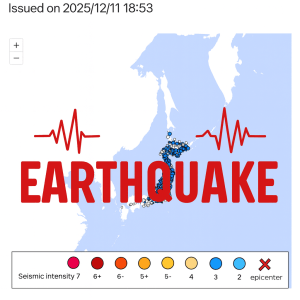
Map issued on December 11 showing seismic intensity levels across Japan, with highlighted epicenter and “EARTHQUAKE” alert overlay.
Epicenter Nearly Identical to December 8 M7.6 Quake
Japan was struck by another strong offshore earthquake on December 12. This prompted new tsunami advisories along parts of the northern Pacific coastline. The Japan Meteorological Agency reported a magnitude 6.7 quake at 11:44 JST off the east coast of Aomori Prefecture. Moreover, the epicenter was located at 40.9N, 143.0E at a depth of 20 kilometers.
Japan Meteorological Agency Issues Tsunami Advisory
The agency issued immediate coastal advisories in Aomori, Iwate and Hokkaido. Wave heights remain under evaluation as officials continue monitoring shoreline activity.

This latest quake strikes the same offshore region where a far larger magnitude 7.6 earthquake hit on December 8. That earlier event produced measurable tsunami waves up to half a meter and triggered widespread alerts across northern Japan. Officials have recorded numerous aftershocks since then, several of them reaching moderate strength.
Seismic Activity Continues in the Same Offshore Zone
The December 12 quake follows a series of strong aftershocks. These have concentrated along the plate boundary east of Aomori and Iwate. The December 8 main shock occurred at:
Date: December 8, 23:15 JST
Latitude: 41.0N
Longitude: 142.3E
Magnitude: 7.6
Depth: 50km
Epicenter: Off the east Coast of Aomori Prefecture
That quake was more powerful and deeper than today’s event. It initiated the current sequence of offshore movement along the northern Japan Trench.
Today’s shock produced wide intensity readings between level 3 and 4 on the Japanese seismic scale across Aomori, Iwate and northern Miyagi. In addition, stronger localized shaking was reported near coastal communities on the Pacific side.
Tsunami Advisories Issued Along Northern Coastline
As of 11:52 JST, Japan’s Meteorological Agency issued updated tsunami advisories for:
• Aomori (Pacific coast)
• Iwate
• Hokkaido’s eastern and southern coastlines
There is no current forecast of widespread destructive waves. Still, even small tsunami heights can pose risks to harbors and low lying coastal areas.
Residents in advisory zones have been asked to stay away from beaches, ports and river mouths until the warnings are lifted.
Officials Warn of Continued Aftershocks
Seismologists caution that repeated quakes of this scale indicate ongoing stress along the offshore fault. In fact, Japan has experienced similar sequences in the past. This typically happens where a major main shock is followed by extended periods of moderate and strong aftershocks.
No Major Damage Reported at This Time
There are no early reports of major damage, transportation shutdowns or impacts to nuclear facilities. Local authorities continue damage checks and safety assessments.
SHR Media will monitor updates from Japanese officials as the situation develops.
This story was written by SHR Media Staff.
About the Author

Discover more from SHR Media
Subscribe to get the latest posts sent to your email.