
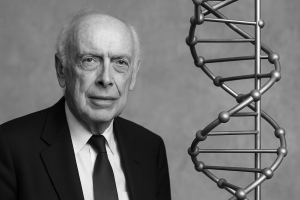
Nobel laureate James Watson’s discovery of DNA’s double helix transformed modern genetics.
By Jersey Joe | Host of Reaver of Common Sense on SHR Media.
James D. Watson, the molecular biologist who helped reveal the double helix structure of DNA and set the course for modern genetics, has died at the age of 97. His death, confirmed by family and the Cold Spring Harbor Laboratory in New York, marks the end of one of the most influential and controversial careers in twentieth century science.
The Discovery That Changed Biology Forever
In 1953, a 24-year-old Watson, then working at Cambridge University, joined British physicist Francis Crick in describing DNA’s structure as a double helix, two twisting strands forming what Watson later called a “beautiful” ladder of life. The finding instantly explained how genetic information is stored and replicated, revolutionizing biology, medicine, and criminal forensics alike.
Watson, Crick, and physicist Maurice Wilkins shared the 1962 Nobel Prize in Physiology or Medicine for the discovery. Their model, partly built on X-ray diffraction data from Rosalind Franklin and Raymond Gosling, became the foundation of molecular genetics and remains one of science’s most recognizable symbols.
From Chicago Prodigy to Scientific Icon
Born in Chicago on April 6, 1928, Watson showed an early fascination with books and the natural world. He entered the University of Chicago at 15, earned a bachelor’s degree at 19, and completed his Ph.D. in zoology at Indiana University by 23. Inspired by early research suggesting that genes might be made of DNA, he traveled to Europe to study nucleic acids, a move that would change both his life and the world’s understanding of life itself.
At Cambridge, Watson met Crick. Their partnership, fueled by youthful competitiveness and intellectual chemistry, produced a breakthrough that decoded biology’s most fundamental structure. As Watson later wrote, “There was no way we could have foreseen the explosive impact of the double helix on science and society.”
Building Institutions and Shaping Modern Science
After two years at the California Institute of Technology, Watson joined Harvard University in 1955. There he developed one of the first academic programs in molecular biology, recruiting and mentoring a generation of scientists who would lead the field for decades.
In 1968 he became director of the Cold Spring Harbor Laboratory (CSHL), eventually serving as its president and later chancellor. Under his leadership, CSHL grew into a premier research institution, focusing heavily on cancer and genetics. Colleagues described Watson as demanding yet visionary, often unpolished but relentlessly dedicated to discovery.
Watson’s reach extended beyond the laboratory. From 1988 to 1992 he directed the National Institutes of Health’s initial effort to map the human genome, advocating for significant funding and, notably, for a built-in ethical-policy arm to explore the social implications of genetic research. His foresight helped shape what became one of the most ambitious scientific collaborations in history.
The Human Genome and Later Years
Watson stood alongside political and scientific leaders at the White House in 2000 as the Human Genome Project announced a “working draft” of roughly 90 percent of the human genetic code. Seven years later, researchers sequenced Watson’s own genome, one of the first individual genetic maps ever published.
He viewed the work not only as a scientific triumph but as a personal mission. Watson’s son Rufus had struggled with schizophrenia, and the elder Watson hoped genomic understanding might lead to treatments for mental illness.
Controversy and Censure
Despite his brilliance, Watson’s reputation was increasingly clouded by inflammatory remarks, particularly regarding race and intelligence.
In 2007, the Sunday Times Magazine of London quoted him saying he was “inherently gloomy about the prospect of Africa” because he doubted that “their intelligence is the same as ours.” The comments provoked widespread outrage, prompting his suspension as chancellor of Cold Spring Harbor Laboratory and his eventual retirement.
A 2019 PBS documentary reignited the debate when Watson reaffirmed his earlier statements. CSHL responded by revoking his honorary titles, calling his comments “reprehensible” and “unsupported by science.”
Dr. Francis Collins, then director of the National Institutes of Health, lamented that “Watson’s views on society and humanity could not match his brilliant scientific insights.”
Even before those incidents, Watson was known for candor that bordered on provocation. In his 1968 memoir The Double Helix, he dismissed “dumb people” in science and encouraged risk-taking, declaring that to succeed “a scientist has to be prepared to get into deep trouble.” The book became a classic of scientific literature and remains both admired and criticized for its blunt portrayal of colleagues, particularly Rosalind Franklin, whose critical data were under-credited for decades.
Legacy of a Complicated Genius
Watson’s legacy mirrors the double helix he discovered, two intertwining strands of brilliance and controversy. His contribution to humanity’s understanding of genetics is undeniable. From cancer research to DNA-based forensics, the applications of his work underpin entire industries and disciplines.
Yet his public remarks on genetics and race overshadowed his final decades, prompting a reckoning over how the scientific community honors pioneers whose personal views diverge from accepted ethics.
Watson once said he did not need a building named after him because “I have the double helix.” The image of DNA, a structure he helped reveal, endures as both monument and cautionary tale: proof that human intellect can achieve the extraordinary, but also a reminder that discovery does not exempt one from accountability.
Final Years and Passing
In his later years, Watson withdrew from public appearances but continued writing and mentoring younger scientists. Family members said he remained intellectually engaged, following advances in gene editing and medicine.
He died in hospice care after a brief illness, according to his son Duncan Watson, who said his father “never stopped fighting for people who were suffering from disease.”
Both of Watson’s Nobel co-laureates, Francis Crick and Maurice Wilkins, died in 2004. Rosalind Franklin, whose X-ray data proved pivotal, died in 1958, four years before the Nobel was awarded.
Editorial Closure
James Watson’s life encapsulates the dual nature of genius, capable of discovery that reshapes the world while revealing deep flaws in human judgment. His story remains a testament to the power of inquiry, the necessity of ethics, and the enduring question of how history should remember those who changed it for better and worse.
👉 Read more about:
Schumer Says Democrats Will Support Funding Bill if ACA Tax Credits Are Included
Trump Unveils Drug Deals Slashing Ozempic Prices by 80%, Expands Obesity Coverage
By Jersey Joe | Host of Reaver of Common Sense on SHR Media
(All information verified through public records, campaign announcements, and reporting from the actual outlets, public records, or documents cited in the article.)
Don’t forget to follow Jersey Joe on X or SHR Media for updates and live show announcements.
© 2025 Jersey Joe | SHR Media. All rights reserved.
Source:
James Watson, co-discoverer of the double helix shape of DNA, has died at age 97 – Associated Press
Additional background from Cold Spring Harbor Laboratory archives and National Institutes of Health historical records.
About the Author

Discover more from SHR Media
Subscribe to get the latest posts sent to your email.