
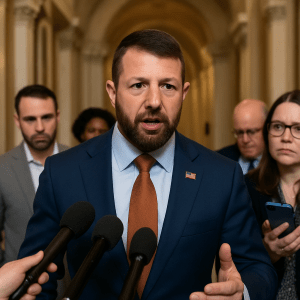
Sen. Markwayne Mullin discusses claims that Majority Leader Chuck Schumer delayed a Senate vote to reopen the government until after Election Day.
By Jersey Joe | Host of Reaver of Common Sense on SHR MediaRecently, discussions surrounding Markwayne Mullin, Schumer, and the shutdown delay have been making headlines.
WASHINGTON, D.C. Senator Markwayne Mullin (R-OK) said Tuesday that Senate Majority Leader Chuck Schumer (D-NY) asked Democratic senators to delay any vote to reopen the federal government until after the November 5 elections, citing discussions that allegedly occurred behind closed doors within the Democratic caucus.
Mullin made the claim in a video statement shared on social media, describing what he called a “back room meeting” in which Schumer urged patience until Election Day had passed. The comment comes as the ongoing government shutdown enters another record-setting week, with millions of federal employees and contractors still affected.
“Because they were afraid their base wouldn’t show up today in Virginia, New Jersey, or New York City,” Mullin said. “Last week, Dick Durbin wanted to break with Democrats and reopen it, but Chuck Schumer in a private meeting with other senators said, wait until after the election, I’ll release the handcuffs. I’m paraphrasing.”
Mullin’s statement immediately sparked debate across Capitol Hill as lawmakers from both parties assess how long the shutdown could continue. While no other senator has confirmed the alleged conversation, the remarks highlight increasing tension within the Senate over how to end the standoff that has shuttered federal agencies for weeks.
Longest Shutdown in Modern History
The partial government shutdown has now become one of the longest in U.S. history. Multiple attempts to reopen the government have failed, including the most recent 14th vote on Monday night.
Republicans have pressed for a straightforward continuing resolution to reopen departments temporarily while broader budget negotiations continue. Democrats have opposed the piecemeal approach, seeking to attach healthcare funding, energy credits, and other policy riders.
According to floor statements recorded by C-SPAN, the Senate remains gridlocked over spending priorities and future budget enforcement language. Agencies affected include the Departments of Agriculture, Transportation, and Commerce, as well as the Small Business Administration and portions of the IRS.
Division Within the Democratic Caucus
Several outlets, including Politico and The Hill, have reported growing frustration among moderate Democrats who are concerned about the optics of an extended shutdown. Senators from competitive states such as Jacky Rosen (D-NV) and Bob Casey (D-PA) have privately expressed concern that the stalemate is politically damaging.
A Politico article described “private agitation” within the caucus and suggested that a few members have begun exploring bipartisan paths to restart negotiations. However, the report stopped short of confirming any specific talks or commitments.
Casey told reporters that while he supports Schumer’s goals, “it’s time to find a path forward that gets people paid.” While none of the remarks directly reference Mullin’s claim, they reflect an undercurrent of unease among swing-state Democrats about the political cost of a prolonged closure.
Breaking Development
Late Tuesday night, reports circulated online that more than a dozen Democratic senators have been in preliminary discussions with Republican colleagues about possible frameworks to reopen the government.
A viral post on X claimed, “There are 12+ Democrat Senators talking with Republicans about opening the government. Democrats are about to cave.” The post, shared widely among political accounts, cited unnamed Hill sources and quickly attracted thousands of interactions.
No official confirmation has been provided by Senate leadership, and no public list of participating senators has been released. However, senior aides speaking to multiple outlets acknowledged that “informal cross-party communications” have occurred throughout the week.
If accurate, such dialogue would represent the most significant internal movement within the Democratic caucus since the shutdown began and could reflect mounting impatience from both parties’ rank and file, who face growing pressure from constituents and federal employees demanding action.
Historical Context
The current standoff mirrors past shutdowns that blended budget disputes with political leverage. The 2013 closure, triggered by disagreements over the Affordable Care Act, lasted 16 days. The 2018-2019 shutdown, the longest on record before now, extended 35 days over border-security funding.
In both prior cases, the party perceived as responsible for prolonging the closure suffered temporary dips in approval ratings, according to Gallup polling. Political analysts say both parties risk backlash if the current impasse continues through mid-November.
Congressional historians also point out that internal caucus pressure has often broken past stalemates. In 1995, moderate Republicans forced an end to the standoff with President Clinton. Similarly, bipartisan Senate cooperation helped reopen the government in early 2019 despite continued White House resistance.
Mullin’s claim, if proven accurate, would indicate a tactical decision by Schumer to preserve voter enthusiasm through Election Day before allowing any compromise, an approach that could carry significant political risks if perceived as partisan obstruction.
Current Senate Dynamics
Floor activity over the past week suggests that behind-the-scenes negotiations are accelerating, even as public statements remain combative. Multiple Senate committees have begun preparing procedural drafts for potential short-term appropriations.
Senate staffers report that bipartisan amendments are being pre-written to ensure quick movement once leadership signals agreement. Sources familiar with the discussions say certain defense and veterans’ provisions have already been tentatively cleared in principle by both sides.
Republican leadership now sits under Senator John Thune (R-SD), who serves as Senate Majority Leader effective January 2025. Thune has publicly committed to preserving the filibuster and steering the chamber’s agenda toward tax cuts, border security, and entitlement reform.
Thune’s presence adds a new dynamic to the negotiations as both parties weigh how far they are willing to go to reopen the government without surrendering major policy objectives.
Public Reaction and Transparency Calls
The allegation that Schumer delayed reopening discussions for political reasons has drawn calls for greater transparency. Some watchdog groups have urged Senate leadership to release internal meeting calendars or summaries of caucus discussions to clarify what occurred.
Public sentiment remains volatile. Polling by Morning Consult shows that 61 percent of voters disapprove of how Congress has handled the shutdown, while only 19 percent express confidence that lawmakers will reach a lasting agreement this month.
Federal employee unions, including the National Treasury Employees Union and the American Federation of Government Employees, have staged demonstrations outside Senate offices in both Washington and regional districts. “We’re not political pawns,” NTEU President Doreen Greenwald said Tuesday. “Every delay affects real families.”
Next Steps
The Senate is expected to reconvene Wednesday morning for further procedural discussions. Floor votes are anticipated later in the week if informal talks produce a bipartisan proposal.
Analysts expect any reopening framework to include a short-term funding extension, likely through January or February, paired with limited policy concessions to both sides.
While the path forward remains uncertain, both parties face mounting pressure to deliver results before Thanksgiving travel disruptions and payroll interruptions further erode public patience.
Editorial Closure
The claim by Senator Mullin and reports of potential cross-party negotiations illustrate how quickly political calculations can shift during a prolonged government shutdown. Whether or not Schumer intentionally delayed action until after the elections, the reality remains that millions of Americans are caught in the middle of a political impasse.
Transparency, compromise, and swift action are now the only remedies that can restore public trust and reopen the doors of government. Until those occur, every new development will continue to fuel debate and deepen the frustration of a weary nation.
👉 Read more about:
Breaking: Major Aircraft Incident Reported at Louisville Airport
AG Bondi Says Special Counsel Seized Trump’s Government Phone During Arctic Frost Probe
Allegations Surface in Chester County Election Process
By Jersey Joe | Host of Reaver of Common Sense on SHR Media
(All information verified through public records, campaign announcements, and reporting from the actual outlets, public records, or documents cited in the article.)
Don’t forget to follow Jersey Joe on X or SHR Media for updates and live show announcements.
© 2025 Jersey Joe | SHR Media. All rights reserved.
Sources
- Politico: “Senate Democrats Agonize Over Endgame as Shutdown Breaks Record” (Nov 2025)
- The Hill: “Moderate Democrats Push for Deal to End Shutdown” (Nov 2025)
- Fox News: “Schumer Blocks 14th GOP Bill to Reopen Government” (Nov 2025)
- Morning Consult: “Voter Confidence Falls as Shutdown Continues” (Nov 2025)
- C-SPAN: Senate Floor Debate Transcripts, November 2025
- X (formerly Twitter): Posts by @SenMullin and @MilaLovesJoe discussing ongoing Senate negotiations
About the Author

Discover more from SHR Media
Subscribe to get the latest posts sent to your email.