
Florida’s Open Carry Ban Ruled Unconstitutional
On September 25, 2025, the First District Court of Appeal in Tallahassee issued a landmark decision thatregarding the Florida open carry law. The court struck down Florida’s open carry ban, declaring it unconstitutional under the Second Amendment. The case, Norman v. State, is one of the most significant gun rights victories in Florida history.
Judge Stephanie Ray wrote the majority opinion, stating, “The Constitution protects the right to carry arms openly for self defense. Florida’s open carry ban cannot be reconciled with that guarantee.”
The ruling draws its foundation from the United States Supreme Court’s 2022 decision in New York State Rifle and Pistol Association v. Bruen. That case reshaped how firearm restrictions are evaluated by demanding that every modern gun law align with America’s historical tradition of firearm regulation.
Florida v. Walkes Extends the Constitutional Shift
Just weeks before the Norman ruling, another major decision came down from the same appellate district. In Florida v. Walkes, the court held that the state’s ban on firearm carry for 18 to 20 year olds was also unconstitutional.
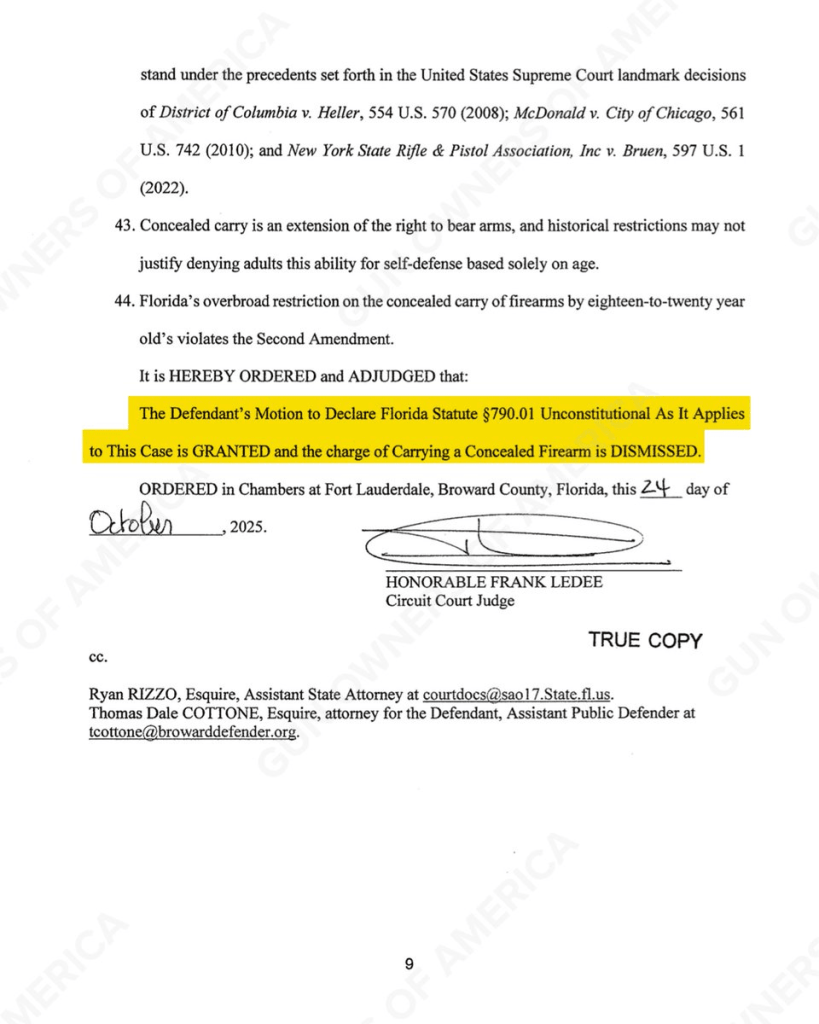
The court determined that the restriction, which barred otherwise law abiding adults under 21 from carrying firearms, violated the Second Amendment and could not be justified by historical precedent.
Judge Adam Tanenbaum, writing for the majority, noted that “those aged 18 to 20 are part of ‘the people’ whose right to keep and bear arms is protected by the Constitution.” The decision rejected the state’s argument that the law was a “reasonable safety measure,” explaining that the Bruen test does not allow modern policy concerns to override constitutional text and history.
Taken together, the Norman and Walkes decisions signal a sweeping realignment of Florida’s firearm laws toward strict constitutional adherence. Both rulings share a clear message: gun rights do not vanish based on age or public visibility.
How the Bruen Standard Changed Everything
Before the Bruen decision, courts followed a two step process. They first determined whether a law affected conduct protected by the Second Amendment, and if it did, they then balanced the government’s interests against individual rights.
The Bruen ruling removed that balancing act entirely. Now, if a law restricts conduct that falls under the Second Amendment, the government must show that the restriction is consistent with the historical understanding of firearm regulation at the time of the Founding or Reconstruction.
In Florida’s open carry case, the state failed to identify any historical precedent supporting a full ban on openly carried firearms. The same reasoning applied in Walkes, where the state could not point to any 18th or 19th century laws categorically disarming adults based solely on age.
Judge Ray concluded that such broad prohibitions “lack historical foundation and cannot survive constitutional review.”
Immediate Impact on Gun Owners
The Norman ruling makes open carry immediately legal in Florida unless overturned by a higher court. Citizens who already meet the concealed carry or permitless carry requirements may now carry their firearms openly in public.
The Walkes decision restores firearm carry rights to Floridians aged 18 to 20, a group that had been restricted since the 2018 Marjory Stoneman Douglas Act. These adults can now lawfully carry firearms under the same standards as any other legal gun owner.
However, several restrictions remain in place. Firearms are still banned in schools, courthouses, polling sites, and certain government buildings. Private businesses may forbid guns on their property. Federal rules still apply in post offices, airplanes, and secured airport areas.
Governor Ron DeSantis praised the rulings as “a long overdue correction that restores constitutional order and common sense.”
Historical Context: Florida’s Shifting Gun Laws
Florida’s modern firearm framework began in 1987, when lawmakers passed the state’s first concealed carry statute, turning the state into a national model for “shall issue” permitting. To calm public fear, the Legislature added a ban on open carry.
That compromise survived for nearly four decades. Then in 2023, Florida implemented permitless carry for concealed firearms, which further exposed the inconsistency of banning open carry for the same citizens.
Critics long argued that the phrase “to bear arms” must include both open and concealed carry. The Norman decision resolves that debate in favor of the constitutional text.
The Walkes ruling added momentum by restoring the rights of 18 to 20 year olds, recognizing that constitutional protections apply equally to all adults.
Red Flag Laws May Be the Next Target
Florida’s Risk Protection Order statute, commonly known as the Red Flag law, allows law enforcement to petition a court to temporarily remove firearms from someone deemed a danger to themselves or others.
Passed after the Parkland tragedy, it remains popular among Democrats and some moderates, but deeply controversial among constitutional scholars. Critics claim it allows confiscation without due process or clear evidence of a crime.
With the courts now applying the Bruen historical test, the Red Flag law could face serious constitutional challenges. Legal analysts expect future cases to attack it under both the Second and Fourteenth Amendments.
Governor DeSantis has voiced skepticism toward Red Flag laws, emphasizing that “a constitutional right cannot depend on a judge’s speculation about future behavior.”
The “Sensitive Places” Debate
The court rulings do not erase all restrictions. Both Heller and Bruen recognized that guns can be barred from “sensitive places” like schools and courthouses. Florida’s laws extend that list to police stations, bars, athletic events, and airports.
Gun rights advocates argue these categories are overly broad and lack historical support. Eighteenth century laws limited such restrictions to narrow contexts such as legislative chambers or trials.
The Supreme Court’s pending case Wolford v. Lopez could redefine this standard nationwide. If the Court narrows what qualifies as a sensitive location, Florida’s list may have to be rewritten once again.
Felon Firearm Bans Face Renewed Scrutiny
Florida prohibits firearm possession by all felons, violent or not. Under the Bruen framework, courts must now determine if such blanket restrictions are historically justified.
Records from the Founding period show that only dangerous or violent offenders were disarmed. Nonviolent felons were not permanently stripped of their rights once their sentences ended.
Justice Amy Coney Barrett has written that early legislatures did not remove gun rights based on criminal status alone. This reasoning could soon threaten Florida’s total ban on felon firearm ownership if the state cannot demonstrate a historical basis.
Public Safety and Individual Responsibility
Critics of these rulings argue that expanding open carry and lowering the age threshold could lead to more risk during protests, traffic stops, and public gatherings. Groups such as Everytown for Gun Safety claim the courts are ignoring public safety data.
Gun rights supporters counter that law abiding citizens are not the cause of violence. They cite states such as Texas and Arizona, where open carry and younger carry rights have existed for years without increased crime rates.
Sheriff Grady Judd summarized it clearly: “Criminals will never follow gun laws. The only people affected by bans are the ones who obey the law. These rulings fix that mistake.”
The new legal environment will require careful law enforcement training and public education to prevent unnecessary confrontations and ensure responsible carry.
Next Steps for Lawmakers
Florida legislators now face several choices. They can appeal the rulings, amend the statutes, or accept the new constitutional standard.
House Speaker Paul Renner stated, “The courts have restored balance between liberty and regulation. Our job now is to update our laws so that they respect both constitutional rights and public safety.”
Lawmakers are expected to craft new bills clarifying where open carry is allowed, ensuring background check integrity, and creating firearm safety programs for 18 to 20 year old carriers.
A National Ripple Effect
Florida’s recent string of court victories could reshape gun law debates across the country. States such as Illinois, New York, and California still maintain strict carry limits that now appear vulnerable under the Bruen standard.
Legal analysts predict that both Norman and Walkes will be cited nationwide as examples of how state level courts are enforcing constitutional fidelity. The trend is clear: any modern restriction must find an authentic historical twin or it will fall.
Conclusion: The Restoration of a Constitutional Right
Florida has now overturned two of its most controversial gun restrictions, the open carry ban and the age based carry prohibition. Together they represent a dramatic return to the original intent of the Second Amendment.
Judge Stephanie Ray captured the essence of this shift in her Norman opinion: “The right to bear arms is not a relic of history. It is a living guarantee of liberty that protects the individual as much today as it did in 1791.”
The combined rulings in Norman and Walkes redefine Florida’s legal landscape. They reaffirm that the right to bear arms belongs to the people, regardless of age or mode of carry.
The next battles will test the state’s red flag law, its list of sensitive places, and its treatment of nonviolent felons. But one thing is certain. Florida has entered a new constitutional era where gun rights, not gun restrictions, set the legal standard.
Don’t forget to follow Jersey Joe on X @JerseyJoeTalks or @SHRMedia for updates and live show announcements.
Internal Links:
California Gas Prices Are Not an Accident
External Link:
Original Florida Political Review Article
This article was written and verified by Jersey Joe, Host of Reaver of Common Sense on SHR Media. All information, quotations, and policy references have been independently confirmed through official records, publicly available reports, and authenticated hearing transcripts.
About the Author

Discover more from SHR Media
Subscribe to get the latest posts sent to your email.