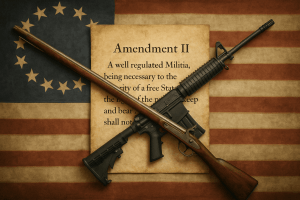
A historical composite illustrating the continuity of the right to keep and bear arms from the founding era to the modern day.
Updated: January 10, 2026
I. How the Second Amendment is Characterized
Every generation seems to rediscover the Second Amendment as though it were a new problem. During election cycles, after high-profile crimes, or amid cultural and political upheaval, calls to restrict or reinterpret the right to keep and bear arms grow louder. Critics often characterize the amendment as outdated, misunderstood, or incompatible with modern society. Yet despite decades of debate, its core meaning and purpose remain unclear to many Americans.
This confusion persists for a reason. The Second Amendment sits at the intersection of history, law, technology, and political philosophy. Commentators often discuss it in isolation and strip it of the context that gave it meaning. Modern arguments frequently impose contemporary assumptions onto eighteenth-century language, producing interpretations that bear little resemblance to what the Founders intended or how early Americans understood the right.
The result is a debate that talks past itself. One side argues from historical principle. The other from modern policy preference. Without a shared understanding of the amendment’s origins, purpose, and early implementation, meaningful discussion becomes impossible.
Table of contents
- I. How the Second Amendment is Characterized
- II. The Historical World That Produced the Second Amendment
- III. What the Second Amendment Says and What It Meant
- IV. Early American Implementation of the Right to Arms
- V. The Courts and the Long Detour from Original Meaning
- A. Arms Early Judicial Understanding
- B. The Post–Civil War Shift
- C. United States v. Miller and Its Misuse
- D. The Rise of the Collective Rights Theory
- E. District of Columbia v. Heller
- F. McDonald v. Chicago and Incorporation
- G. New York State Rifle and Pistol Association v. Bruen
- H. Ongoing Resistance
- Section V Takeaway
- VI. Modern Arguments Against the Second Amendment
- A. Background Checks and Crime Reduction Claims
- B. The Claim That Police Protection Makes Civilian Arms Unnecessary
- C. Gun Registration and the Voting Analogy
- D. Regulate Guns Like Cars
- E. Firearms Technology and the Myth of Muskets
- F. Weapons of War and Civilian Ownership
- G. Federal Regulation of Automatic Firearms
- H. Misuse of Statistics and Emotional Framing
- Section VI Takeaway
- VII. A Right Designed to Endure
Why it Still Matters
This article does not attempt to reduce the Second Amendment to a slogan or talking point.Instead, it examines the right to keep and bear arms as the Founders conceived and practiced it. That requires looking beyond modern rhetoric and returning to the historical record: the conditions that produced the amendment, the language chosen to protect it, its early legal implementation, and the long judicial detour that reshaped its interpretation.
Understanding the Second Amendment on its own terms does not require agreement with every modern application of it. It requires intellectual honesty. Before debating what the amendment should mean today, readers must first understand its original meaning and why the Founders deemed it necessary to the security of a free people.
That is the purpose of this examination. Any serious examination of the Second Amendment must begin with the historical conditions that made it necessary.
II. The Historical World That Produced the Second Amendment
The Second Amendment did not emerge in isolation. Lived experience, political philosophy, and direct confrontation with centralized power shaped it. For the Founders, questions of arms ownership were not abstract or theoretical. They were matters of survival, resistance, and self-government.
Understanding the amendment requires understanding the world that produced it.
A. English Precedents and the Politics of Disarmament
American attitudes toward arms drew heavily from English history. British authorities often tied weapons ownership to class, religion, and political loyalty. The English Bill of Rights of 1689 recognized a limited right for Protestants to possess arms, but the Crown constrained that right and enforced it selectively.
Disarmament was routinely used as a tool of political control. Authorities restricted weapons access among groups viewed as disloyal to the crown. These practices reinforced the understanding that arms control was less about public safety and more about consolidating power.
The Founders inherited this suspicion. They saw that when governments feared dissent, disarmament often followed.
B. Standing Armies and the Fear of Centralized Power
Distrust of standing armies was a defining feature of eighteenth-century political thought. European history offered repeated examples of professional armies being used to suppress domestic populations and enforce unpopular laws.
The American colonists experienced this firsthand. British authorities stationed troops among civilian populations, quartered them in private homes, and used them to impose imperial authority. Many Americans viewed a permanent peacetime army as incompatible with liberty.
This fear shaped early American governance. The Articles of Confederation sharply limited federal military power. Even during the Constitutional Convention, opposition to standing armies remained intense. The militia system was seen as the alternative. A citizen force composed of the people themselves was viewed as a safeguard against both foreign invasion and domestic tyranny.
C. Disarmament and the Road to Revolution
As tensions between the colonies and the British crown escalated, control of arms became a central issue. British authorities understood that an armed population posed a direct challenge to imperial authority. Colonial leaders understood the same.
Beginning in the early 1770s, British officials attempted to restrict colonial access to firearms and gunpowder. Storage facilities were seized. Powder supplies were removed. The crown issued orders to prevent importation and confiscate existing arms where possible.
These actions were not symbolic. They were strategic efforts to render the colonies incapable of organized resistance. Colonists interpreted them as such.
The confrontation at Lexington and Concord was the culmination of these efforts. British troops were dispatched with orders to seize colonial military stores. The engagement that followed marked the opening shots of the American Revolution.
This experience left a permanent imprint on the Founders. They did not view arms ownership as a peripheral issue. They understood that political liberty could not survive once the means of resistance were removed.
D. Natural Rights Theory
The political philosophy that shaped the American founding was grounded in natural rights theory. Among its most influential figures were John Locke and William Blackstone, whose writings were widely read and cited by the Founders.
John Locke argued that individuals possess natural rights to life, liberty, and property that exist prior to the formation of government. These rights did not originate from rulers or institutions. They were inherent to human beings. According to Locke, individuals entered into social contracts, not to surrender these rights, but to secure them more effectively through collective governance.
Crucially, Locke maintained that when government failed to protect natural rights, or actively violated them, it forfeited its legitimacy. In such cases, resistance was not rebellion in a moral sense. It was a justified act of self-defense. The right of resistance flowed directly from the same natural law principles that justified self-preservation.
The influence of this framework is evident throughout American revolutionary thought. The Founders adopted Locke’s reasoning to justify armed resistance against British rule. They did not view that resistance as lawless violence. They viewed it as the lawful exercise of a pre-existing right when the social contract had been breached.
Justification for Resistance
William Blackstone further developed this understanding in his Commentaries on the Laws of England, a foundational legal text for American lawyers and statesmen. Blackstone described the right to bear arms as an auxiliary right. It was not an end in itself, but a means of protecting more fundamental natural rights, particularly self-preservation.
Blackstone emphasized that crimes against natural law, such as murder, justified defensive force. Because the law cannot always act in time to prevent harm, individuals inherently have the right to defend themselves. Arms were the most effective and practical means by which that right could be exercised. Without them, the right to self-defense would be theoretical rather than real.
This conception of arms bearing was tightly bound to responsibility. The right existed to prevent injustice, not to create disorder. It was rooted in the moral obligation to preserve life and resist unlawful force.
The Second Amendment reflects this philosophical lineage. It protects the means people use to defend their natural rights against both private violence and government tyranny. The amendment does not elevate arms above other rights. It recognizes them as necessary to securing those rights when other protections fail.
E. Arms Ownership as Civic Responsibility
In colonial and early American society, citizens closely linked arms to civic responsibility. Communities expected citizens to contribute to their own defense. Militia obligations formalized this expectation, but broader cultural norms reinforced it.
Firearms were common household tools. They were used for personal defense, public service, and hunting. Ownership was unremarkable and nearly universal. It did not carry the political stigma often associated with it today.
Americans understood participation in the militia as both a right and a duty. Responsibility accompanied ownership. Americans viewed an armed citizenry not as a dangerous force, but as a stabilizing one. They expected citizens to maintain training, readiness, and discipline.
This context matters. The Second Amendment was written to preserve an existing social and legal reality. It did not attempt to create a new right or introduce a novel concept. It sought to protect a system that Americans already believed was essential to their freedom.
Section II Takeaway
The Second Amendment was shaped by experience, not abstraction. The Founders had seen how disarmament enabled oppression and how standing armies threatened liberty. They believed that a free people required both the right and the means to defend themselves.
This historical backdrop explains why the right to keep and bear arms was considered essential. It was not about preference or convenience. It was about preserving self-government in a world where power was often asserted at the point of a bayonet.
These experiences and beliefs shaped not only the Founders’ fears, but the precise language they chose to enshrine in the Constitution.
III. What the Second Amendment Says and What It Meant
The Second Amendment is only twenty-seven words long. The Framers chose each word in response to specific historical concerns. Despite its brevity, it has generated more confusion, distortion, and deliberate misreading than any other provision of the Bill of Rights. Much of the modern debate revolves not around what the amendment actually says, but around what critics wish it said. To understand the text correctly, readers must read it as the Founders did—through the language, legal conventions, and political realities of the late eighteenth century.
The amendment reads:
“A well regulated Militia, being necessary to the security of a free State, the right of the people to keep and bear Arms, shall not be infringed.”
Each clause matters. None negates the others.
A. A Well Regulated Militia
The phrase “well regulated” represents the most frequently misused language in the Second Amendment. Contemporary political debate often treats it as a synonym for government control, licensing schemes, and bureaucratic oversight. That interpretation would have been foreign to the Founders.
In eighteenth-century usage, well regulated meant properly functioning, well maintained, or in good working order. A well regulated clock kept accurate time. A well regulated militia was trained, equipped, disciplined, and ready. The term described condition and capability, not restriction.
Fundamentally, regulation did not imply centralized state control of arms ownership. Militia laws of the era assumed that citizens already possessed their own weapons. Regulation focused on training, inspections, and readiness, not permission to own arms in the first place.
The militia was not a professional force distinct from the population. As George Mason explained during the ratification debates, the militia consisted of the whole people, except a few public officers. A militia drawn from the people necessarily presupposed an armed citizenry.
B. Being Necessary to the Security of a Free State
This clause explains why the militia mattered. It does not limit the right. It justifies its protection.
The phrase free state does not refer to state governments as modern administrative entities. It refers to a political condition, a society not ruled by tyranny. For the Founders, security meant far more than crime prevention. It meant protection against foreign invasion, domestic insurrection, and abuse of power by one’s own government.
The Founders had just fought a war against a regime that used a standing army to enforce unjust laws and suppress dissent. They understood that liberty could not survive if the population were dependent on the government for protection while being denied the means to resist it.
A free state required a people capable of defending themselves both collectively and individually. If the militia was to be the mechanism, arms ownership was the prerequisite.
C. The Right of the People
The phrase the people appears repeatedly throughout the Bill of Rights. The Constitution uses the phrase in the First Amendment to protect assembly and petition, in the Fourth Amendment to guard against unreasonable searches and seizures, and again in the Ninth and Tenth Amendments to reserve rights and powers.
In every other instance, the people refers to individual citizens, not a collective institution or government-controlled body. There is no textual or historical basis for interpreting the phrase differently in the Second Amendment.
If the First Amendment protects an individual right to speak, and the Fourth protects an individual right to be secure in one’s home, then the Second protects an individual right to keep and bear arms. Any attempt to read it otherwise relies on contorted logic that collapses under even minimal scrutiny.
D. To Keep and Bear Arms
To keep arms meant to possess them, and to bear arms meant to carry them. At the time of the Founding, writers used the phrase in both military and civilian contexts, including public carry, self defense, and hunting.
Nothing in the historical record confines the right to militia service or limits it to government-issued weapons. Early American law assumed civilian ownership as the norm. Militia members were expected to appear with their own arms suitable for military use.
The fact that arms could be used militarily was not a flaw. It was the point. The Founders did not intend the people to be armed with inferior tools. They intended the population to possess arms of the type commonly used by soldiers of the era.
E. Shall Not Be Infringed
This final clause is the strongest rights protective language in the Constitution. “Shall not be infringed” forbids the government from regulating the right at its discretion or weighing it against policy preferences. It is a command.
An infringement is any encroachment that weakens or undermines the exercise of a right. The Founders understood that rights erode not only through outright bans but through incremental burdens, delays, and conditions that make their exercise impractical.
The Founders framed the Second Amendment as a restriction on government power, not as a grant of permission. The right already existed. The amendment exists to prevent its violation.
F. Drafts, Debates, and Intent
The drafting history of the Second Amendment reinforces its meaning. Early proposals, committee drafts, and ratification debates consistently described the militia as composed of the body of the people and the right to arms as belonging to them individually.
At no point during the drafting process did Congress suggest that the right was collective only or contingent on government approval. The Founders’ writings repeatedly emphasize that an armed citizenry was essential to liberty.
Section III Takeaway
The Second Amendment is neither ambiguous nor obsolete. Its language is precise, its purpose explicit, and its meaning reinforced by drafting history and the Founders’ own words. Misunderstanding it requires ignoring how the Founders used language, how militias functioned, and what they feared most.
Those facts, once acknowledged, fundamentally reshape the modern debate.
IV. Early American Implementation of the Right to Arms
Early American practice confirms what the text and drafting history already show. The Second Amendment was not theoretical. It was operational.
The Founders built a system that depended on an armed population.
A. Mandatory Service and Arms Ownership
Militia service was mandatory for most able-bodied men. Arms ownership was part of that obligation.
The Militia Act of 1792 required citizens to equip themselves with firearms, ammunition, and related equipment. The government did not issue weapons to the population. It assumed citizens already possessed them.
This reality contradicts the claim that the Second Amendment was merely a collective right exercised at government discretion.
B. What Regulation Meant in Practice
Regulation meant readiness.
Militia laws required training, inspection, and drills. Inspections verified that arms were functional. A lack of arms resulted in penalties.
There were no licensing schemes or registries. Regulation improved readiness. It did not restrict ownership.
C. Early Firearms Laws
Early governments addressed misuse, not possession.
Laws punished criminal behavior, negligent discharge, and dangerous conduct. They did not ban common firearms or limit the quantity one could own. They did not require prior approval.
These omissions were deliberate.
D. Arms Suitable for Defense
Militia members were expected to possess arms suitable for military service. Civilian and military arms were not meaningfully separated.
This parity was intentional. A militia armed with inferior weapons would be ineffective as a safeguard of liberty.
E. Federal and State Authority
The Constitution divided militia authority between federal and state governments. Neither possessed the authority to disarm the people.
The system relied on decentralized arms ownership as a safeguard against centralized power.
F. Arms Ownership as Normal Life
Firearms ownership was ordinary. It was not exceptional or suspect.
The idea of government tracking or approving weapons ownership would have been viewed as both dangerous and foreign. For generations, this understanding was widely accepted, requiring little if any judicial explanation.
V. The Courts and the Long Detour from Original Meaning
If the Second Amendment was clearly written, widely understood, and consistently implemented in early America, a reasonable question follows. How did its meaning become so distorted in modern law and politics.
The answer lies not in the Founding era, but in a long judicial detour that gradually separated the amendment from its original context.
A. Arms Early Judicial Understanding
The Second Amendment was rarely litigated for much of America’s History. This was not because the text was unclear, but because it was largely uncontested. Courts and lawmakers operated under the assumption that arms ownership was lawful and ordinary.
Early state court decisions treated the right to keep and bear arms as individual in nature, even when upholding limited regulations on misuse or manner of carry (Bliss v. Commonwealth, 1822; Nunn v. State, 1846). None treated the Second Amendment as obsolete or collective only.
The lack of constant litigation reflected cultural consensus, not ambiguity.
B. The Post–Civil War Shift
The Civil War marked a turning point in American constitutional law. In its aftermath, federal authority expanded, and the balance between citizens and centralized power began to change.
During Reconstruction, Southern states enacted Black Codes that explicitly disarmed newly freed Black Americans. These laws were enforced selectively and often violently. Congressional debates from this period repeatedly identified arms ownership as essential to personal security for freedmen (Congressional Globe, 39th Cong., 1st Sess.; Freedmen’s Bureau Act of 1866).
In response, Congress passed the Fourteenth Amendment to protect individual rights from state infringement. Historical analysis later recognized by the Supreme Court confirms that the right to keep and bear arms was central to these civil rights protections (McDonald v. Chicago, 2010).
Ironically, the Fourteenth Amendment reinforced individual liberty, but later courts applied it unevenly and declined to incorporate the Second Amendment for decades. (United States v. Cruikshank, 1876; Presser v. Illinois, 1886).
C. United States v. Miller and Its Misuse
The Supreme Court’s 1939 decision in United States v. Miller is often cited as justification for modern gun control. The case does not support that claim.
Miller addressed whether a short-barreled shotgun had a reasonable relationship to militia service. The defendants did not appear, and no defense brief was ever submitted. The Court ruled without an evidentiary record on the weapon’s military utility (United States v. Miller, 1939).
The decision did not reject an individual right to arms. It assumed militia relevance as the standard and left broader questions unanswered. Later courts misused Miller to promote a collective rights theory that the opinion itself never articulated, a point the Supreme Court later clarified explicitly (District of Columbia v. Heller, 2008).
D. The Rise of the Collective Rights Theory
In the mid-twentieth century, academic reinterpretations of the Second Amendment gained traction. These theories framed the amendment as protecting only state militias rather than individual citizens.
This interpretation conflicted with the text, drafting history, and early judicial understanding of the right. Nevertheless, it persisted for decades as the Supreme Court declined to address the issue directly.
As a result, the Second Amendment became the only right in the Bill of Rights routinely treated as conditional or outdated.
E. District of Columbia v. Heller
In 2008, the Supreme Court at last directly addressed the issue.
In District of Columbia v. Heller, the Court held that the Second Amendment protects an individual right to possess firearms for lawful purposes, including self-defense within the home. The Court rejected the collective rights theory and grounded its decision in text and history (Heller, 2008).
The ruling reaffirmed an existing right. It did not create a new one.
F. McDonald v. Chicago and Incorporation
Two years later, the Court held that the Second Amendment applies to the states through the Fourteenth Amendment (McDonald v. Chicago, 2010).
The decision confirmed that the right to keep and bear arms is fundamental and limits state power in the same manner as other enumerated rights.
G. New York State Rifle and Pistol Association v. Bruen
In 2022, the Court reinforced this framework in New York State Rifle and Pistol Association v. Bruen.
Bruen rejected interest-balancing tests that allowed judges to weigh constitutional rights against policy preferences. The Court held that modern firearms regulations must be consistent with the text, history, and tradition of the Second Amendment (Bruen, 2022).
H. Ongoing Resistance
Despite clear guidance from the Supreme Court, some lower courts continue to treat the Second Amendment differently from other rights. Courts uphold laws regulating arms that would be impermissible if applied to speech or religion.
This resistance reflects institutional discomfort with a right designed to limit government power.
Section V Takeaway
Modern confusion surrounding the Second Amendment did not arise from the Founding era. It emerged from judicial avoidance, academic reinterpretation, and decades of organized political activism that reframed the right in public discourse.
As judicial interpretation drifted, the resulting gap was filled by oversimplified narratives and political arguments that reshaped public understanding of the right.
When courts returned to the foundations of text and history, the right reasserted itself.
The remaining conflict is not over meaning, but over application.
VI. Modern Arguments Against the Second Amendment
With the historical meaning of the Second Amendment established and its judicial treatment explained, the modern debate and its recurring arguments come into clearer focus. Many contemporary arguments against the right to keep and bear arms do not arise from new constitutional insight. They are recurring claims that persist largely through repetition rather than historical or legal grounding.
This section addresses the most common arguments directly, not as an attempt to persuade, but to clarify where they diverge from history, law, and data.
A. Background Checks and Crime Reduction Claims
One of the most common claims is that expanding background checks will significantly reduce violent crime. This argument assumes that criminals acquire most firearms used in crimes through lawful retail channels.
Federal law already requires background checks for all purchases from licensed dealers. Data collected by the Bureau of Justice Statistics shows that individuals who commit gun crimes most often acquire firearms through theft, black market transactions, or informal transfers rather than direct retail purchase (Bureau of Justice Statistics, Firearm Use by Offenders).
Policies that expand background check requirements primarily affect lawful ownership while leaving criminal acquisition pathways unaddressed.
B. The Claim That Police Protection Makes Civilian Arms Unnecessary
Another frequent assertion is that private firearms are unnecessary because law enforcement exists to provide protection.
Courts have repeatedly held that police departments do not have a legal duty to protect individual citizens from harm (DeShaney v. Winnebago County, 1989; Town of Castle Rock v. Gonzales, 2005). Even where police presence is strong, response times often exceed the duration of violent encounters.
Self-defense is an immediate need. Law enforcement response is reactive by nature. The right to keep and bear arms exists in part to address that gap.
C. Gun Registration and the Voting Analogy
Some advocates compare firearm registration to voter registration, arguing that both are reasonable administrative measures. The analogy does not hold.
Voter registration serves to prevent fraud in a discrete civic process. Firearm registration creates a permanent record of ownership that allows tracking of individuals and their property. Historically, registration schemes have often preceded restrictions or confiscation rather than prevented crime.
The two systems serve different purposes and carry different risks.
D. Regulate Guns Like Cars
Proponents frequently compare firearm regulation to automobile regulation, but the analogy fails under scrutiny.
Driving is a licensed activity. Arms ownership is a constitutional right. Automobiles are not subject to background checks at purchase. There are no limits on the number of vehicles an individual may own. States recognize driver’s licenses issued by other states nationwide.
Applying the automobile regulatory model consistently would expand gun rights rather than restrict them. For that reason, the comparison collapses under scrutiny.
E. Firearms Technology and the Myth of Muskets
Critics argue that the Second Amendment applied only to muskets and therefore cannot apply to modern firearms.
This claim rests on a misunderstanding of both history and constitutional design. Repeating and multi-shot firearms existed before and during the Founding era, including the Belton repeating flintlock, the Girandoni air rifle, pepperbox firearms, and early volley guns. Military planners and political leaders knew about these types of weapons, but cost prevented their widespread issuance.
The Founders lived during a period of rapid technological change. They drafted the Constitution in principles rather than product specifications. The Founders wrote constitutional rights broadly so they would remain effective as technology evolved. Free speech was not limited to quill pens, and the right to arms was not limited to single-shot weapons.
Freezing the Second Amendment at eighteenth-century technology would defeat its purpose.
F. Weapons of War and Civilian Ownership
Modern rhetoric frequently labels common firearms as weapons of war. This framing obscures historical reality.
At the Founding, society expected civilians to possess arms suitable for military service. The militia system depended on parity rather than inferiority. The fact that a firearm had military utility did not disqualify it from civilian ownership. It historically justified it.
The AR-15, often cited in this context, is a semi-automatic rifle. It does not fire multiple rounds with a single press of the trigger. The platform functions mechanically like many common handguns. Millions of Americans own it and use it for lawful purposes.
G. Federal Regulation of Automatic Firearms
Federal law has long distinguished between semi-automatic firearms and fully automatic weapons.
The National Firearms Act of 1934 imposed strict regulation on machine guns, short-barreled rifles, short-barreled shotguns, and suppressors. Rather than banning these items outright, the Act required registration, background checks, and the payment of a federal tax (National Firearms Act of 1934).
In 1986, Congress further restricted civilian access to machine guns through the Firearm Owners Protection Act. One provision of that law prohibited civilian possession of machine guns manufactured after May 19, 1986. Civilians may only lawfully acquire machine guns produced before that date, and only through the registration and approval process established by the National Firearms Act (Firearm Owners Protection Act of 1986).
Federal law has tightly regulated fully automatic firearms for decades as a result. They are rare, expensive, and largely absent from ordinary criminal activity. Modern debates that conflate commonly owned semi-automatic firearms with machine guns overlook this established legal framework.
H. Misuse of Statistics and Emotional Framing
Policy advocates frequently cite statistics to justify restrictive policies without adequate context. Claims that firearms are the leading cause of death for children frequently rely on data sets that include legal adults and gang-related violence.
A proper separation of those variables produces markedly different conclusions. Emotional framing replaces precision, and policy discussions become driven by headlines rather than data.
This pattern is not unique to gun policy, but it is especially prevalent in this debate.
Section VI Takeaway
Modern arguments against the Second Amendment rely less on constitutional analysis than on emotional appeal, flawed analogies, and selective use of data. When examined closely, these arguments do not align with the amendment’s text, its historical purpose, or its treatment in law.
Understanding that gap helps explain why the debate persists despite centuries of constitutional clarity.
VII. A Right Designed to Endure
The Founders did not write the Second Amendment casually or without foresight. It emerged from a specific historical experience and reflected a deliberate choice by the Founders to place limits on government power. They understood that liberty required more than good intentions. It required structural safeguards.
Across its text, drafting history, early implementation, and judicial treatment, the amendment reflects a consistent principle. The Founders understood the right to keep and bear arms as an individual right tied to the preservation of a free people. It was not a temporary measure or a historical accident. It was a deliberate restraint on centralized authority.
Much of the modern confusion surrounding the Second Amendment stems from viewing it through a contemporary lens detached from its historical origins. Legal reinterpretation, academic revision, and sustained political activism reshaped how people discussed and applied the right. Over time, that shift created a gap between the amendment as written and the amendment as commonly described.
Recent Supreme Court decisions have attempted to close that gap by returning to text, history, and tradition. Whether those efforts succeed fully remains an open question. What is clear is that the Second Amendment has not lost its relevance. It continues to serve the same function it always has. It defines a boundary the government was never meant to cross.
Understanding the Second Amendment does not require uniform agreement on policy. It requires honesty about history and clarity about constitutional limits. Without that foundation, debate becomes untethered from the document that governs it.
The Second Amendment was not designed to be comfortable or convenient. It was designed to endure.
No. In the landmark case District of Columbia v. Heller (2008), the Supreme Court clarified that the Second Amendment protects an individual right to possess a firearm unconnected with service in a militia. The Court ruled that the “prefatory clause” regarding a well-regulated militia explains the purpose of the amendment but does not limit the “operative clause” which guarantees the “right of the people” to keep and bear arms.
Established in NYSRPA v. Bruen (2022), this is the current legal standard used by courts to determine if a gun law is constitutional. Under this test, if the text of the Second Amendment covers an individual’s conduct, the government must prove that the regulation is consistent with the Nation’s historical tradition of firearm regulation. If there is no historical analogue from the founding era, the law is often found unconstitutional.
Yes. In Caetano v. Massachusetts (2016), the Supreme Court unanimously stated that the Second Amendment extends to all instruments that constitute bearable arms, even those that were not in existence at the time of the founding. While certain “dangerous and unusual” weapons may be regulated, arms in “common use” for lawful purposes are generally protected.
Following the Bruen decision, the Court ruled that the right to “bear” arms includes the right to carry them in public for self-defense. While states can designate certain “sensitive places” (like schools or government buildings) as gun-free zones, they cannot pass “may-issue” laws that give officials broad discretion to deny carry permits to law-abiding citizens.
While the right is fundamental, it is not absolute. The Supreme Court has noted that “presumptively lawful” prohibitions remain, including those barring convicted felons and the mentally ill from firearm possession. However, as of 2026, many of these categories are being challenged in lower courts to see if they meet the “History and Tradition” standard.
Earl “Big E” Jackson is the host of The Mission Ready Men Briefing, a conservative commentary series where conviction meets culture.
Watch full episodes on Rumble and YouTube, and find daily updates on X (formerly Twitter).
For patriotic apparel and gear, visit MissionReadyMen.com — Apparel for the Patriotic Man of God.
About the Author

Discover more from SHR Media
Subscribe to get the latest posts sent to your email.






I wish more people understood why the founders made the 2nd Amendment the way that they did. It is imperative people understand this.