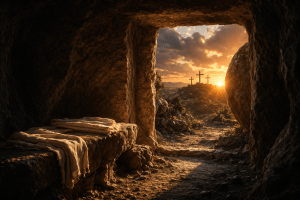
From inside the empty tomb, folded burial cloths remain as sunrise light reveals the cross on the horizon
Why Easter Still Draws a Line the Culture Can’t Cross
Every year, Resurrection Sunday shows up like clockwork.
Pastels. Sunday best. Bunnies. Brunch reservations. Cultural Christianity on autopilot.
When you strip all that away, you’re left with something far more disruptive.
Truth that refuses to stay buried.
A man executed by the state didn’t stay dead.
And according to Jesus Christ, that wasn’t just a miracle. It was the point.
“I am the resurrection and the life.” (John 11:25)
Not a teacher of it. Not a symbol of it.
The resurrection.
The life.
That statement doesn’t leave room for soft interpretations or seasonal reflection pieces. It demands a decision.

The Moment Everything Turns
Christianity does not stand or fall on suggestions about how to be a good person.
It stands on a single event.
The resurrection.
The Apostle Paul made that clear. If Christ has not been raised, your faith is futile. (1 Corinthians 15:17)
If it didn’t happen, the whole thing collapses. Moral teaching. Church tradition. Every sermon ever preached.
All of it becomes well-meaning fiction.
But if it did happen, then everything changes.
Death is no longer the final authority. (1 Corinthians 15:55)
Sin no longer defines us. (Romans 6:9-10)
Human life is no longer disposable.
Resurrection Sunday draws a clear dividing line, whether people want to acknowledge it or not.
Not Just Life. The Source of Life
When Jesus says he is the resurrection and the life, he isn’t offering comfort. He’s making a declaration of authority.
Jesus Christ is the Son of God. His resurrection validates this fact. He was “declared to be the Son of God in power… by his resurrection from the dead.” (Romans 1:4)
It confirms his divine nature and sinless character.
It also fulfills the Old Testament scriptures that prophesied Jesus’ suffering and resurrection. Scriptures that he quoted while on the cross. (Psalm 22)
“In the beginning was the Word, and the Word was with God, and the Word was God.” (John 1:1)
Life does not originate in human systems. It doesn’t come from government recognition or cultural consensus.
It comes from God.
“Then God said, ‘Let us make man in our image.’” (Genesis 1:26)
That truth runs throughout Scripture. Humanity is not an accident. It is intentional.
Made in the image of God.
The Imago Dei.
And Scripture is even more specific.
“You knit me together in my mother’s womb.” (Psalm 139:13)
That means something simple, yet inconvenient in today’s cultural environment.
Human value is not assigned. It is inherent.
We cannot earn it, negotiate for it, or vote on it.
It is given.
The Collision With Modern Thinking
Here’s where things start to rub.
If human life carries inherent value because it reflects the image of God, then that value does not fluctuate based on a person’s stage of development, size, location, or dependency.
Before birth. After birth. At strength or at weakness.
“Before I formed you in the womb I knew you.” (Jeremiah 1:5)
Value isn’t conferred when it becomes useful.
It doesn’t increase when it becomes independent.
And it doesn’t expire when it becomes inconvenient.
That creates tension in a culture that increasingly treats personhood as conditional.
Our culture asks who counts. Christianity answers everyone.
Not because of sentiment. Because our creator says so. Jesus sacrificed His life for us because human life has inherent value.
That value is established by his love.
Easter Is Not Neutral
This is why Resurrection Sunday never stays contained to church services.
It spills into everything.
Law. Ethics. Policy. Culture.
It follows that if the resurrection is true, then life has a source outside human control.
And if life has a source outside human control, then human beings don’t get to redefine its value on the fly.
“All authority in heaven and on earth has been given to me.” (Matthew 28:18)
That’s the part that creates friction.
Not the holiday.
The implication.
The Empty Tomb and the Living Question
The empty tomb doesn’t point backward. It points forward.
It presents us with a question that demands an answer.
If Jesus rose from the dead, and he is who he says he is, then what does that mean for how we see life itself?
Not in the abstract, but practically.
“I am the way, and the truth, and the life.” (John 14:6)
The conversation changes once you understand that life is something given by God, not granted by government or society.
Then it becomes less about preference and more about truth.
Closing
Resurrection Sunday is not a seasonal tradition.
It is a statement about reality.
A holy declaration that life does not end in the grave.
“Why do you seek the living among the dead? He is not here, but has risen.” (Luke 24:5-6)
And that life, all life, carries a value that cannot be appraised based on cultural vagaries or redefined based on earthly standards.
That is the good news of the resurrection.
And it’s exactly why it still unnerves people.
Because if Jesus was raised from the dead, and he really is the resurrection and the life, then the question isn’t what we believe about Easter.
The question is what Easter demands we believe about life.
“Big E”
Earl “Big E” Jackson is the host of The Mission Ready Men Briefing on the SHR Media network. The opinions expressed in this article are his own and reflect a commitment to Biblical principles, primary source research and constitutional literacy.
Support Independent Media – Keep Liberty Alive
Enjoyed this article? At SHR Media we are fully independent and refuse to hide truth behind a paywall. Every piece of our journalism is built for you and by you. If you believe in honest reporting, free speech, and holding those in power accountable, your support matters. Even the smallest contribution helps us fight censorship and shine a light on the stories the mainstream media ignores.
About the Author

Discover more from SHR Media
Subscribe to get the latest posts sent to your email.