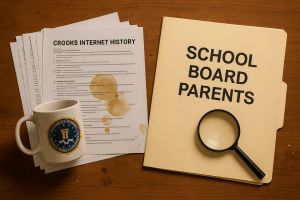
A staged depiction of an FBI desk showing a pristine “School Board Parents” folder under a magnifying glass while a coffee cup sits on top of “Crooks Internet History” papers, symbolizing overlooked online activity.
by: Sack Head Shaun
After a new report from New York Post columnist Miranda Devine, significant questions are resurfacing about attempted Trump assassin Thomas Crooks and what federal authorities knew before the Butler Pennsylvania shooting. Devine’s article outlines publicly available online material that contradicts earlier statements from investigators who described Crooks as having almost no digital footprint and no meaningful signs of violent extremism.
Early Posts Show a Shift in Political Views
According to Devine’s sourcing, Crooks had a large online presence across several platforms. His posts show a shift in his political views over time, beginning in late 2019 when he made comments calling to “murder the Democrats.” By early 2020 he was criticizing President Trump during the impeachment hearings and calling Trump supporters a cult. He also labeled President Trump a racist.
This online activity continued into the Covid pandemic, a period that several studies from institutions such as Johns Hopkins identified as high risk for mental health deterioration among young people.
Rhetoric Escalated Into Talk of Terrorism
Devine reports that by August 2020 Crooks’ rhetoric escalated into open talk about terrorism, including statements on how to fight the government through “terrorism style attacks.” He wrote about planting bombs in essential buildings and assassinating “important people.” At that time he was almost 18 years old, which placed him within the age group experts say was most affected by lockdowns and social isolation.
A PayPal Alias Raises New Questions
The NY Post investigation also highlights Crooks’ use of a PayPal account under the name “Rod Swanson.” That name matches a former senior FBI agent who later served as chief of investigations for the state of Nevada during the 2017 mass shooting in Las Vegas. Swanson has Pennsylvania ties but told Devine he had never heard of Crooks and was never contacted by the FBI after the assassination attempt.
Swanson also noted that federal authorities usually create a record after any credible threat and someone “knocks on somebody’s door” when concerning posts surface online. He suggested that if Crooks had been investigated there would be documentation, and if he was not investigated it would mean someone decided he was not a threat.
Crooks Engaged With Extremists and Identity Communities
Devine’s report also shows that Crooks was active in the furry community and explored gender identity on platforms such as DeviantArt where he used they or them pronouns. She also links Crooks to an online figure known as Willy Tepes, a self described Neo Nazi associated with the Nordic Resistance Movement, which is classified as a terrorist group in Norway. According to the NY Post, Tepes encouraged Crooks toward violent extremism.
Federal Monitoring Raises Oversight Concerns
These findings raise new questions about whether Crooks was ever flagged by federal agencies. Throughout the last several years the federal government has monitored a wide range of online activity. This includes what the Brennan Center calls “situational awareness” programs in which DHS components track keywords such as “attack,” “public health,” “jihad,” and other terms across social media. The center’s own documents show few limits on what content can be reviewed.
During the same period the FBI investigated parents at school board meetings, arrested protesters outside abortion clinics, and even placed current DNI Director Tulsi Gabbard on a watch list despite her top secret clearance and military service. Federal doctrine under the Biden administration also identified white males as the primary terrorism threat in the United States. Crooks fit the demographic. Yet federal agencies have not confirmed any prior awareness of his posts or his escalating rhetoric.
Key Questions Remain Unanswered
This leaves a simple question. Was Crooks ever flagged, and if not why not. If he was flagged, why was no action taken. Devine’s investigation does not answer those questions, but it shows that important information was available online long before the attempt on President Trump’s life. The gaps in this case continue to raise concerns about federal priorities and oversight. Where there choice “groups” who were ignored because they were in a group that was seemingly “politically protected” or was there something more? If so, “That’s a hell of a high price to pay for being stylish“
Sack Head Shaun is a talk show host and writer for SHR Media and The Loftus Party. He covers national politics, current events, and federal accountability issues with a focus on verified sourcing and clear reporting. His work can be found on the SHR Media Network and across the platform’s broadcast outlets.
About the Author

Discover more from SHR Media
Subscribe to get the latest posts sent to your email.