
A Billion Dollar Building and a Wall of Silence
The California Capitol Annex Project is causing a stir as California’s state government has quietly built itself a new palace, and it is the taxpayers footing the ever-rising bill.
What began in 2018 as a $543 million modernization project for the State Capitol Annex in Sacramento has now exploded to upward of $1.6 billion, according to multiple reports from KCRA 3, CalMatters, and Newsweek.
Despite the staggering price tag, California’s Democrat-controlled legislature has refused to release detailed cost records, contracts, or updates to the public, or even to lawmakers demanding transparency.
Critics call it “the most secretive public construction project in state history.” And they are not far off.
The Project That Started as a Renovation Then Became a Rebuild
The Capitol Annex Project was first pitched under former Governor Jerry Brown and carried forward under Governor Gavin Newsom. The stated goal was to update the dilapidated east wing of the Capitol, which houses lawmakers’ offices and committee rooms.
The Legislature said the Annex was unsafe, outdated, and lacked accessibility compliance. The fix was to tear it down and replace it with a new, larger structure featuring underground parking and a visitor center.
In 2018, project planners told the public it would cost about $543 million — a massive investment, but one supposedly justified by safety concerns and long-term savings. At the time, legislative leaders promised full transparency.
Six years later, not only has the cost ballooned nearly threefold, but basic financial information — including line-item budgets, change orders, and vendor payments — remains sealed from the public.
A Culture of Secrecy Inside the Statehouse
According to KCRA 3 Investigates, which has filed multiple public-records requests, the Joint Rules Committee (JRC) — controlled by Democratic leadership — has repeatedly refused to provide updated cost data or contractor invoices.
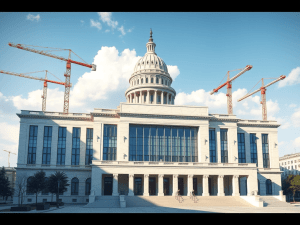
When pressed, legislative spokespeople claimed the information was “under review” or “not finalized,” even as construction cranes continued to loom over downtown Sacramento.
Sources close to the project confirmed that thousands of workers have been required to sign non-disclosure agreements (NDAs). In other words, those physically building the new Capitol are legally barred from discussing its progress, costs, or design details.
“We can’t get a straight answer out of anyone,” one legislative staffer told KCRA 3. “It’s public money, but the public isn’t allowed to know how it’s being spent.”
A Building Fit for Kings Not Taxpayers
Renderings of the project show a sprawling complex of glass, marble, and underground tunnels connecting to the historic Capitol.
The visitor center alone is estimated to exceed $130 million. Additional expenses include seismic retrofitting, landscaping, and high-security infrastructure that critics say goes far beyond functional renovation.
Newsweek reported that the project’s total cost now “rivals the annual budget of small states” and may even exceed $1.6 billion depending on inflation, design modifications, and legal disputes.
Meanwhile, the public gets only heavily filtered updates.
There’s no official running tally of expenditures.
No database of awarded contracts.
No breakdown of change orders that pushed the cost upward.
Transparency, it seems, was value-engineered out of the project.
Bipartisan Outrage: “This Is Not How You Run a Democracy”
While most criticism has come from Republicans, even some Democrats have begun privately expressing discomfort.
State Senator Brian Jones (R-San Diego) blasted the lack of disclosure, calling it “an insult to every taxpayer in this state.”
“If this were a Republican administration hiding billion-dollar cost overruns,” he said, “Democrats would be screaming corruption.”
The California Republican Assembly has urged the state auditor to intervene, arguing that the Legislature has circumvented standard procurement rules by placing the Joint Rules Committee in charge of its own building project.
In practical terms, that means lawmakers are both the client and contractor, with no independent oversight.
Even open-government groups — traditionally aligned with the left — have expressed alarm.
The First Amendment Coalition and CalMatters both criticized the use of NDAs and the Legislature’s refusal to honor public-records requests.
“It undermines trust in government when such massive sums of taxpayer money are spent behind closed doors,” said FAC attorney David Loy.
For related coverage on government accountability, read: Left-Wing Violence in America: The Truth They Hide on SHR Media.
The Capitol Annex Project: Timeline of Broken Promises
| Year | Milestone | Estimated Cost |
|---|---|---|
| 2018 | Project announced under Gov. Brown | $543 million |
| 2019 | Environmental impact reports filed | $650 million |
| 2020 | COVID delays, design changes | $775 million |
| 2021 | Legal challenges and injunctions | $950 million |
| 2022 | Construction resumes | $1.2 billion |
| 2024 | No public update given | $1.1 – $1.6 billion |
The trend speaks for itself. Each year brings new design “adjustments” and revised estimates but no transparent explanation for the overruns.
NDAs and Legislative Privilege
Perhaps the most alarming revelation is that the Legislature reportedly invoked legislative privilege to shield project documents from California’s Public Records Act.
Unlike executive agencies, the Legislature is exempt from certain transparency laws. In practice, that means they can deny access to spending documents with minimal justification.
Thousands of construction personnel and consultants were also asked to sign NDAs — an unprecedented step for a taxpayer-funded public works project.
“It’s like they’re building a casino, not a Capitol,” one industry source remarked.
Such secrecy has fueled speculation about who profits from the project. The primary contractor, Turner Construction, has not disclosed detailed invoices or subcontractor lists. Architectural firms involved have declined interviews.
The People Locked Out of Their Own Capitol
Beyond financial opacity, the project has also displaced the public. The west steps of the Capitol — once a traditional site for protests, rallies, and civic events — were closed for construction and fenced off for years.
Activists sued, alleging that the state violated free-speech rights by effectively erasing a historic public forum.
Although some access has since been restored, the lawsuit continues, and critics say the new underground visitor center is designed to funnel and limit public demonstrations.
In other words, Californians paid billions for a new Capitol and got fewer rights in return.
Gavin Newsom’s Role and Political Fallout
Governor Newsom’s office has attempted to distance itself from the controversy, claiming the Legislature, not the executive branch, controls the project.
Yet Newsom publicly supported the modernization and has repeatedly held press events touting Sacramento’s “commitment to sustainability and innovation.”
Critics say it’s impossible for the state’s chief executive to wash his hands of a billion-dollar boondoggle happening just blocks from his office.
The optics are especially bad as California faces budget shortfalls exceeding $40 billion, rising homelessness, and mass exodus of businesses.
The Capitol Annex has become a symbol of Sacramento’s misplaced priorities — luxurious self-investment while ordinary Californians struggle under record inflation, power shortages, and soaring taxes.
Calls for Investigation Grow Louder
Watchdog groups, taxpayer associations, and media outlets are now calling for a full state audit.
Even California’s Legislative Analyst’s Office (LAO) has admitted it cannot accurately verify the total cost due to limited access.
The Howard Jarvis Taxpayers Association demanded criminal review if any public funds were misused. “This project reeks of insider deals and concealed overruns,” the group said in a statement.
If an audit moves forward, it could expose not only cost mismanagement but also violations of procurement law, contract favoritism, and possible misuse of contingency funds.
Internal Link: For a deeper look at misplaced government priorities, see: Democrats Are Building Databases to Track ICE Agents
Don’t forget to follow Jersey Joe on X @JerseyJoeTalks or @SHRMedia for updates and live show announcements.
By Jersey Joe, Host of Reaver of Common Sense on SHR Media
(All information verified through publicly available government documents, state budget filings, and investigative reports from KCRA 3, CalMatters, and Newsweek.)
About the Author

Discover more from SHR Media
Subscribe to get the latest posts sent to your email.