

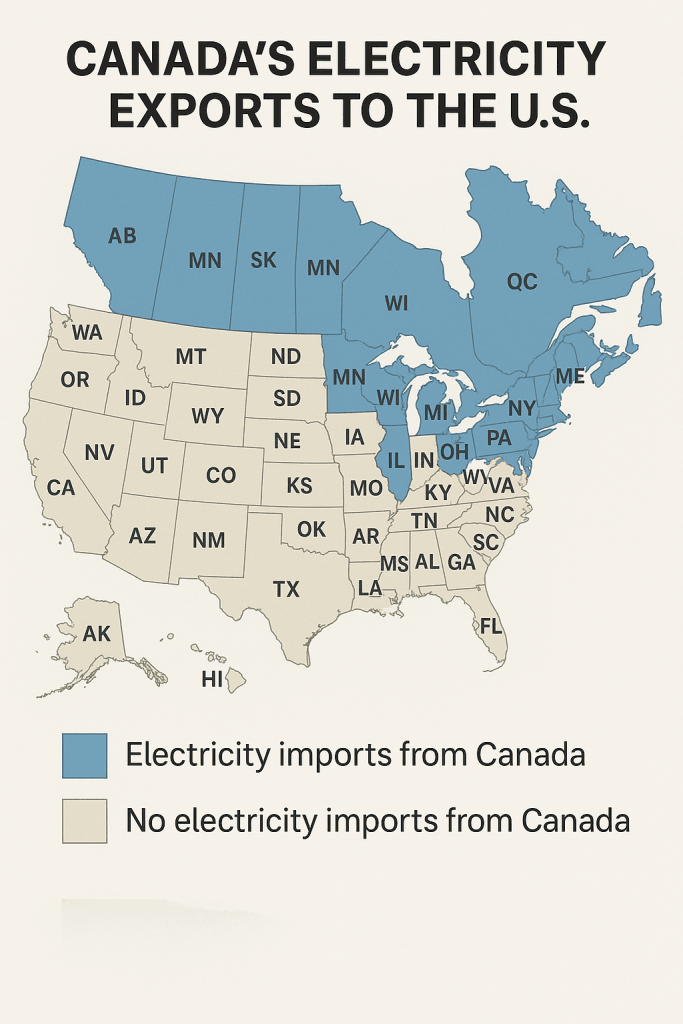
Featured image for SHR Media’s fact-check article debunking the viral claim that Canada supplies electricity to all 50 U.S. states. The design includes a regional map and clear headline typography for professional news presentation.
A viral social media claim recently stated: “We’re not the poor northern cousin. We supply electricity to all 50 U.S. states. Imagine if we turned it off.”
The post, widely circulated on X (formerly Twitter) and Facebook, suggests that Canada powers every state in America and could cripple the U.S. economy by halting electricity exports.
However, government data and international trade records show this claim is false. Canada does export electricity to the United States, but not to all 50 states, and the scale is far smaller than the viral narrative implies.
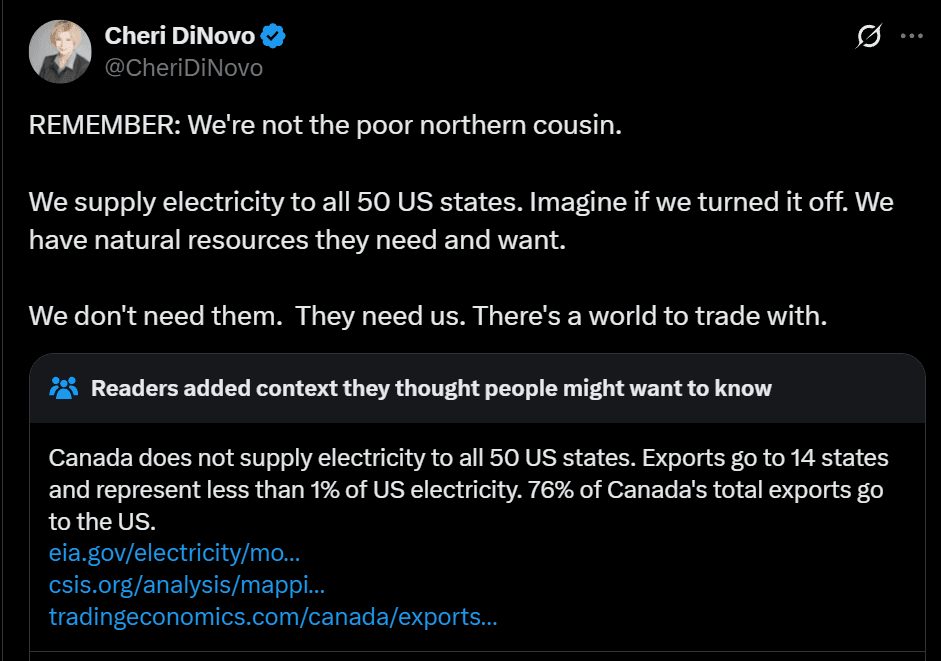
Screenshot of a post by Cheri DiNovo on X, originally posted October 2025. Used under fair use for commentary and fact-check purposes.
Canada’s Actual Role in U.S. Electricity Supply
According to the U.S. Energy Information Administration (EIA), about 1.9 percent of total U.S. electricity consumed in 2024 came from Canada. The power flows across 37 major transmission lines that link Canadian provinces to 15 northern U.S. states, primarily along the shared border.
[Insert map: Cross border transmission lines between U.S. and Canada, EIA 2024]
The majority of Canadian electricity imports go to states such as New York, Vermont, Maine, Michigan, Minnesota, North Dakota, Washington, and Montana. Some additional power flows into New England’s regional grid, reaching Massachusetts, Connecticut, and New Hampshire.
No electricity is directly supplied to southern, western, or non contiguous states like Florida, Texas, Arizona, or Hawaii.
How the Cross Border Grid Works
Electricity trade between Canada and the United States is governed by the North American Electric Reliability Corporation (NERC) and coordinated through regional grids, not national monopolies.
There are six major grid interconnections between the two countries, each operating independently. The most significant is the Eastern Interconnection, which handles roughly 75 percent of cross border flows. Smaller grids link Manitoba to Minnesota, Alberta to Montana, and British Columbia to Washington.
[Insert chart: U.S. Canada electricity flows by region, EIA 2024]
This structure means electricity imports depend on market demand, regional shortages, and seasonal variations, not political leverage or national control.
Export Volume and Value
Data from Trading Economics and Natural Resources Canada show that electricity exports totaled approximately $3.8 billion USD in 2024, a minor fraction of Canada’s overall $800 billion in exports to the U.S.
By comparison, Canada exports far more in oil, natural gas, and minerals — those sectors dwarf the power trade.
Hydroelectricity, the cornerstone of Canada’s energy exports, represents about 97 percent of electricity traded with the U.S. Provinces such as Québec, Manitoba, and British Columbia dominate the market, using vast hydro facilities like Hydro Québec’s La Grande Complex and BC Hydro’s Peace River system.
Why the Claim Spread
The viral post plays into a popular perception that Canada’s abundant natural resources give it outsized leverage over the United States. But energy experts say the notion of Canada “powering all 50 states” is an exaggeration of a complex, cooperative trade.
Dr. Christopher Sands of the Center for Strategic and International Studies (CSIS) explained that electricity exports function within joint reliability agreements, not unilateral control. “Both countries depend on each other for grid stability. Canada sends hydro power south; the U.S. supplies natural gas and seasonal balancing power north,” Sands told CSIS Energy Forum in March 2025.
In other words, the U.S.–Canada electricity relationship is mutually beneficial, not one sided.
Interconnected, Not Dependent
The idea that Canada could “turn off” U.S. power misrepresents how the North American grid works. Electricity cannot simply be disconnected across borders without major consequences, including for Canadian provinces that rely on U.S. markets for surplus sales.
EIA data show that while Canada exports around 60 terawatt hours (TWh) annually to the U.S., it also imports nearly 10 TWh back, especially during peak winter demand. Both countries rely on this reciprocal system to stabilize prices and manage renewable energy fluctuations.
What the Numbers Actually Mean
- Canada supplies: roughly 1.9 percent of U.S. electricity
- Only 15 U.S. states receive Canadian power
- 85 percent of U.S. electricity is produced domestically from natural gas, renewables, nuclear, and coal
- Cross border electricity trade is cooperative, not coercive
These figures show that the viral claim is factually incorrect. Canada does not and cannot “supply electricity to all 50 states.”
Canada’s Broader Energy Trade with the U.S.
While electricity plays a limited role, Canada remains a critical energy partner overall. It is the largest foreign supplier of crude oil to the U.S., providing about 52 percent of imports in 2024, and also a leading exporter of natural gas, uranium, and refined petroleum products.
These markets are deeply integrated, but again, trade is mutual. The United States supplies Canada with gasoline, refined fuels, and energy technology.
Expert and Agency Assessments
The U.S. Department of Energy (DOE) confirmed in a 2024 report that cross border electricity flows “enhance reliability and reduce costs for both nations.” It emphasized that these transfers occur under market based export permits, not political directives.
Similarly, Natural Resources Canada noted that “Canada and the U.S. have developed a high degree of integration and interdependence in their electricity systems — the relationship is built on reliability and reciprocity.”
Both agencies agree that no single country holds a “switch” that could turn off the other.
Historical Context
Electric power trade between the two nations dates back to the early 1900s when utilities in Ontario and New York first connected across the Niagara River. Since then, infrastructure and cooperation have expanded under binational agreements such as the 1959 Columbia River Treaty and the 1980s U.S. Canada Free Trade Energy Framework.
Those agreements prioritize grid stability and fair pricing, preventing either side from weaponizing electricity as leverage.
Why Accuracy Matters
Energy misinformation can affect public policy, especially when it exaggerates economic leverage or national dependence. Claims like “Canada could turn off America’s power” misrepresent the cooperative foundation of North American energy security and may encourage false nationalistic narratives.
Fact checking these statements helps maintain an informed debate about resource management, trade agreements, and regional energy independence.
Conclusion
The claim that “Canada supplies electricity to all 50 U.S. states” is false. Canada provides limited hydroelectric exports to a handful of northern states under long standing cooperative agreements. The U.S. electric grid is overwhelmingly domestic, diversified, and designed to prevent dependency on any single foreign source.
Canada and the United States are energy partners, not adversaries, and neither can simply “turn off” the other.
For more on government transparency and spending oversight, see SHR Media’s investigation:
California’s $1.6 Billion Capitol Project: A Secretive Boondoggle
Don’t forget to follow Jersey Joe on X @JerseyJoeTalks or @SHRMedia for updates and live show announcements.
(All information verified through publicly available government documents, state budget filings, and investigative reports from KCRA 3, CalMatters, and Newsweek.)
© 2025 Jersey Joe | SHR Media. All rights reserved.
About the Author

Discover more from SHR Media
Subscribe to get the latest posts sent to your email.