
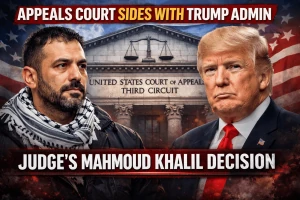
Appeals Court Sides With Trump Admin — Judge’s Mahmoud Khalil Decision
By Jersey Joe | Host of Reaver of Common Sense on SHR Media
A federal appeals court has sided with the Trump administration. It reversed a lower court decision that ordered the release of activist Mahmoud Khalil from immigration detention. This action reinforces long-standing limits on judicial interference in immigration enforcement.
The ruling delivers a clear message. District court judges do not get to override the statutory immigration process simply because a case is politically charged.
Appeals Court: Lower Judge Lacked Jurisdiction
In a 2–1 decision, the U.S. Court of Appeals for the Third Circuit made a ruling. It stated that the federal judge did not have jurisdiction to order Khalil’s release.
The panel held that challenges to immigration detention and removal must continue through the immigration court system established by Congress. Federal district courts can’t short-circuit that process through habeas orders when no final removal decision has been issued.
In plain terms, the appeals court said the judge stepped outside his authority.
What the Case Is and Is Not About
This ruling does not decide whether Khalil will ultimately be deported. It does not rule on the merits of his claims. And it does not prevent him from raising constitutional arguments in the proper forum.
What it does is reaffirm that immigration law is governed by statute, not judicial preference.
Khalil is a legal permanent resident tied to high-profile pro-Palestinian activism. He was detained by ICE. Federal authorities alleged immigration violations. These violations were tied to misrepresentations and national security concerns. A district judge ordered his release, citing constitutional issues and alleged overreach by the executive branch.
That order has now been overturned.
Why This Ruling Matters
This case goes far beyond one individual.
For years, activist judges have attempted to use sympathetic defendants as vehicles to undermine federal immigration enforcement. When courts substitute ideology for jurisdiction, the result is chaos, inconsistency, and selective enforcement of the law.
The appeals court ruling restores a basic principle:
Congress writes immigration law. Immigration courts apply it. Federal judges do not get to rewrite it from the bench.
A Broader Pattern of Judicial Overreach
The Khalil case fits a growing pattern where district courts attempt to block or reverse executive actions without statutory authority. The appeals court’s decision signals that those days are not unlimited.
If challenges to immigration enforcement are going to succeed, they must survive the legal process Congress created, not bypass it.
That distinction matters, especially as political actors increasingly weaponize immigration enforcement.
Bottom Line
The Trump administration prevailed because the law was on its side.
The appeals court did not weigh politics. It weighed jurisdiction. And when it did, the answer was clear: the lower court overstepped.
That is not controversial.That is how the rule of law functions.
Don’t forget to follow Jersey Joe on X or SHR Media for updates and live show announcements.
© 2025 Jersey Joe | SHR Media. All rights reserved.
Support Independent Media – Keep Common Sense Alive
Enjoyed this article? At SHR Media we are fully independent and refuse to hide truth behind a paywall. We build every piece of our journalism for you and with you.
If you believe in honest reporting, free speech, and holding those in power accountable, then your support truly matters.
Moreover, even the smallest contribution helps us fight censorship. It also shines a light on the stories the mainstream media works to ignore.
👉 Donate Today and Help Keep Independent Journalism Alive
About the Author

Discover more from SHR Media
Subscribe to get the latest posts sent to your email.