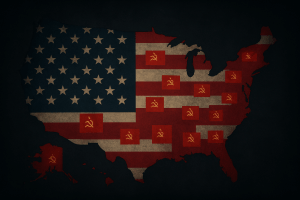
A stylized U.S. map with faint CCP emblems scattered across the nation, symbolizing foreign influence within American borders.
By Sack Head Shaun | SHR Media Staff
The Quiet Invasion
While Americans debate inflation, elections, and wars abroad, another front has quietly opened here at home. The Chinese Communist Party has spent the last decade expanding espionage, political influence, and physical presence inside the United States. From university labs to farmland near military bases, the pattern is clear. It is a coordinated long term plan to plant roots inside the American system itself.
Political Infiltration, The Front Door of Espionage
The Fang Fang Network
The now well known case of Christine Fang, also called “Fang Fang,” revealed how China recruits influence assets early and close to power. Between 2011 and 2015, Fang built relationships with rising California Democrats, including Congressman Eric Swalwell, organizing fundraisers, placing interns, and using personal ties to gain access.
The FBI quietly briefed Swalwell in 2015, after which he cut off contact, but by that time Fang had already fled the country. This was not an isolated case. It was a method: identify young politicians, gain influence, and wait.
Note: During this time, Nancy Pelosi, then House Minority Leader, reportedly told colleagues to treat the Swalwell and Fang story as “Republican distraction politics.” There is no evidence linking Pelosi to any agent or direct cover up, but her decision to shield a member who had been briefed on a foreign influence case remains a serious lapse in judgment.
Senior Access Breach, The Feinstein and Hochul Cases
Feinstein’s Driver
For decades, Senator Dianne Feinstein was one of the most powerful Democrats in Washington. In 2018, news surfaced that her longtime driver and aide, Fang Dawei, also called “Michael Fang,” had been investigated by the FBI for suspected ties to Chinese intelligence. The Bureau advised Feinstein to remove him after confirming ongoing contact with officials from the Chinese consulate in San Francisco.
No charges were filed, but the incident showed how close Chinese intelligence had come to one of the Senate’s most senior members, including a former chair of the Intelligence Committee.
New York Governor Kathy Hochul’s Staffer
In April 2023, infiltration reached eastward. A Hochul staffer named Mildred “Middy” Xu was accused of acting as an undeclared agent of the Chinese Communist Party. Reports claimed Xu passed political and constituent information to Chinese contacts while employed in the governor’s office.
The FBI has not confirmed a formal indictment, but the case follows a familiar pattern of recruitment through staff, friends, and social networks.
(Unverified: Federal charges have not been publicly filed as of November 2025.)
Espionage in the Labs and Beyond
Between 2015 and 2025, U.S. prosecutors charged more than fifty people with espionage, acting as unregistered agents, or assisting Chinese intelligence services. A growing number of these cases involve theft and smuggling of biological material, a quieter but more alarming battlefield.
- Zaosong Zheng was arrested in 2019 at Boston Logan Airport with twenty one vials stolen from Beth Israel Deaconess labs, affiliated with Harvard Medical School. He was convicted of lying to federal agents.
- Yunqing Jian, Zunyong Liu, and Chengxuan Han were charged in 2025 in Michigan for smuggling Fusarium graminearum, a pathogen identified by the USDA as a potential agro terrorism risk.
- Xu Bai, Fengfan Zhang, and Zhiyong Zhang were charged in November 2025 for conspiring to export biological samples and falsifying customs forms.
That makes seven confirmed people caught in biological or agricultural espionage since 2019, each with a link to China based collaborators.
Police Stations, Fox Hunt, and Digital Control
China’s operations on U.S. soil go far beyond traditional spying. They now include law enforcement impersonation and digital surveillance.
- In 2023, Lu Jianwang and Chen Jinping were charged for running an illegal Chinese police outpost in New York’s Chinatown. Chen later pled guilty to acting as an unregistered agent of the Chinese government.
- The Department of Justice charged fourteen people in 2020 and 2022 under Operation Fox Hunt for stalking and threatening Chinese dissidents living in the U.S., part of an effort to pressure them to return to China.
- In September 2025, the Secret Service and FBI seized a Chinese telecom data center in New York containing over three hundred servers and one hundred thousand SIM cards used to reroute phone traffic. Officials said it posed an “imminent threat” to American emergency networks.
The Land War, Acres, Access, and Advantage
According to the USDA’s 2023 AFIDA Report, Chinese linked buyers now own or control about three hundred eighty four thousand acres of U.S. land, up from seventy five thousand in 2010. That represents less than one percent of all foreign held farmland, but many parcels are located near sensitive areas such as Grand Forks Air Force Base in North Dakota and Laughlin Air Force Base in Texas.
The Trump administration and several states have moved to restrict or ban Chinese acquisitions of land. The concern is not volume, but proximity to military, agricultural, and energy infrastructure, where even one strategically placed parcel could provide access for surveillance.
One Strategy, Many Fronts
Each part of this pattern serves a purpose. Political infiltration weakens oversight. Academic and biological espionage supports Chinese defense development. Transnational repression keeps expatriates under control. Strategic land purchases give proximity to critical locations.
This is called civil military fusion, the Chinese government’s method of merging commercial, political, and intelligence activities under one unified national mission.
America’s Blind Spot
For years, Washington ignored the trend, often for partisan reasons. Pelosi’s defense of Swalwell, Feinstein’s silence about her driver, and universities’ willingness to accept Chinese funding all contributed to a blind spot that let this network grow. Only now, as prosecutions multiply and states impose restrictions, is the true scope becoming visible.
What Comes Next
Congress is currently debating legislation to block foreign ownership of land near sensitive facilities, increase academic background checks, and restore elements of the Department of Justice’s China Initiative. Intelligence officials warn that these steps may come too late. The network is already in place, and undoing it will require political courage that has so far been in short supply.
Conclusion
The Chinese Communist Party’s campaign is not a theory. It is already happening. From state offices to farmland near military bases, the CCP has placed influence, infrastructure, and information pipelines inside the United States. The first step is to admit it. The next step is to stop it.
Sources
- Department of Justice Press Releases 2018–2025
- U.S. Department of Agriculture AFIDA Reports 2023–2024
- CSIS Chinese Espionage Incident Tracker
- Reuters
- Axios
- Associated Press
- Business Insider
- South China Morning Post
- LA Magazine
- FBI Briefings
- Right Angle News via X
Editorial Closing
For continued coverage of America’s ongoing fight against foreign infiltration and political corruption, watch The Edge of Liberty with Sack Head Shaun, airing live every Monday and Wednesday night on the SHR Media Network.
About the Author

Discover more from SHR Media
Subscribe to get the latest posts sent to your email.