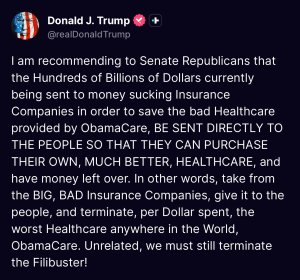
President Trump posted on Truth Social that Obamacare funding should go directly to the people — not insurers.
President Trump posted to Truth Social that the money Washington sends to insurance companies under Obamacare should instead go directly to the people. The political class will lose its mind over this, claiming it can’t work, that it would wreck coverage, that it’s too simple. It isn’t simple, but it is possible. It would also be better.
The same people who swore Obamacare would “bend the cost curve” also swore it would last forever. Many of us said from the beginning it wouldn’t because it was never designed to fix anything, only to feed the insurance companies and hospital groups.
Let’s go through the math and see the changes Congress would have to make, and how this approach would finally break the monopolies that made care unaffordable in the first place.
The math the critics hide behind
The Affordable Care Act’s subsidies, what Washington actually sends to insurers, aren’t large if you divide them up.
Federal spending on ACA premium tax credits: about $92 billion in 2023 and $138 billion projected for 2025.
With roughly 163 million taxpayers, that’s only $46–$71 per month if you just cut everyone a check.
That’s why critics say “See, it can’t work.” They’re right only if you keep the rest of the system untouched. If Congress actually fixes the law, this plan could work and work bigly.
What Congress must do for the plan to work
Each step below includes how it fixes the system and who benefits.
Convert insurer subsidies into portable consumer credits
Change the ACA tax credit language so the money follows the person, not the insurer. Credits can fund any qualified plan or HSA.
Benefit: Individual choice. Consumers, not bureaucrats, decide what plan to buy and what is right for them.
Create national reinsurance and high-risk pools
Protect the system from premium spikes when high-cost cases hit. States using this model have seen 10–20 percent premium drops. Imagine seeing a premium drop? Wild, I know.
Benefit: Lower premiums across the board.
Crack hospital monopolies and enforce real price transparency
Many metropolitan areas are highly concentrated. When one or two systems control care, prices climb. Enforce antitrust law, ban exclusive contracts, and pay the same for the same service whether it’s at a hospital or clinic.
Benefit: 10–15 percent price reduction, better access, no quality loss. Everyone wins.
Allow interstate competition for insurers
Let a plan licensed in one state sell nationwide under uniform consumer protection rules.
Benefit: 15–25 percent lower individual premiums, 5–10 percent lower employer costs from new competition. Think of the change in auto insurance and how prices dropped once that market opened.
Legalize consumer association plans
Allow churches, trade groups, or even ten neighbors to pool and buy insurance with the same tax treatment as employer plans. Why isn’t this already allowed? Because it would give more choice and buying power to the people, that’s why. This needs to be fixed.
Benefit: Small groups gain bargaining power, prices fall.
Run the ACA and the new model side by side for two to three years
No one gets dropped mid-treatment. The new system phases in as the old phases out. Unlike Obamacare’s failed promise, you could actually keep your doctor and your plan if you liked it.
Benefit: Smooth transition, zero coverage cliff.
The impact in real numbers
| Market | Expected Savings | Who Gains |
|---|---|---|
| Individual / Exchange | 25–40 percent lower premiums | Families, self-employed |
| Employer Plans | 20–30 percent lower costs | Businesses, workers |
| Employees | Lower paycheck deductions | Every worker with ESI |
| Medical Staff | Wages stay competitive, no socialist pay caps | Nurses, doctors, techs |
These savings come from transparency, competition, and administrative simplification, not from cutting anyone’s pay. The nurses and doctors don’t deserve the socialized-medicine treatment you see in other countries. They deserve to be paid well for their skills and training.
Why this beats socialized medicine
Single-payer systems “save” money by rationing care and suppressing wages. This plan saves money by competition and innovation. Hospitals would finally have to justify their prices. Insurers would have to earn your business. Workers keep their pay scale tied to performance and demand, not a government spreadsheet. Bonus: no waiting six months to have a broken ankle reset, meaning people can actually go back to their lives in a timely manner instead of sitting at home, potentially on taxpayer-funded disability, waiting to go back to work.
The bottom line
Obamacare was never a fix, it was a metaphorical time bomb on insurance to eventually usher in the single-payer system. It was designed to implode by all accounts. Why else would it have been designed so poorly? Many of us, myself included, have said publicly for years that was the case.
But Congress needs to have the stones to take on this challenge. To make actual change, that may seem difficult and confusing at first but actually fixes the healthcare system without a socialism-based system where wait times increase, doctors are underpaid, and services are minimized to save money in the system.
Plus, it puts the patients in the driver’s seat. It actually gives them control, something that Obamacare promised and never delivered. We liked our doctors but couldn’t keep them. We liked our health plans but they went away or got more expensive.
This would actually be effective, and why not try something that has a bright future instead of keeping the status quo that’s bankrupting people on copays and deductibles while throwing taxpayer cash at hospitals and insurance groups?
History favors the bold. This change would be huge for the American people. It would save thousands a year for individuals, business owners offering ESI, and the taxpayers who are supplementing the system for those who need help.
Congress, the ball is in your court.
Editorial Closing
Obamacare’s collapse wasn’t a surprise, it was inevitable. It handed power to the same corporate monopolies that created the cost crisis and left taxpayers holding the bill. President Trump’s call to send the money directly to Americans is the first serious step toward returning power to patients, families, and small businesses.
If Congress wants real reform, it has to stop defending a broken system and start trusting the American people to decide what’s best for themselves. That’s how you fix healthcare in a free country.
By Sack Head Shaun
© 2025 SHR Media | All Rights Reserved
Sources
- Trump urges lawmakers to give healthcare money “directly to the people” — Reuters, Nov. 8 2025
- Trump calls for sending Obamacare funds directly to citizens — Fox News, Nov. 8 2025
- Congressional Budget Office, The Premium Tax Credit and Related Spending, July 2024 Baseline
- Peter G. Peterson Foundation, How the Federal Government Subsidizes Healthcare under the ACA (2023)
- Committee for a Responsible Federal Budget, Understanding the ACA Subsidy Discussion, Dec. 2025
- Internal Revenue Service Data Book (2023): 163 million individual returns
- National Institutes of Health / PMC, Effects of State Reinsurance Programs on Premiums (2023)
- Kaiser Family Foundation, Section 1332 State Innovation Waivers and Reinsurance Outcomes
- American Medical Association, Competition in Hospital Markets 2013–2021
- Kaiser Family Foundation, Ten Things to Know About Consolidation in Health Care Provider Markets
- Congressional Budget Office, Site-Neutral Payment Options for Medicare and Private Insurers
About the Author

Discover more from SHR Media
Subscribe to get the latest posts sent to your email.