
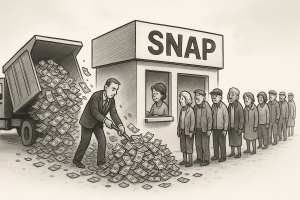
Illustration representing the Cloward/Piven strategy—lines of benefit recipients on one side of a SNAP office, and taxpayer money being shoveled in from the other.
How It Is Still Trying to Crash American Cities
In 1966, Columbia University sociologists Richard Cloward and Frances Fox Piven published a blueprint in The Nation titled “The Weight of the Poor.” Their plan was simple but destructive: flood the nation’s welfare system until it collapses under its own weight. When local and state programs fail, the federal government steps in with a “solution.” That “solution” is always the same—centralized control, redistribution, and dependency.
That strategy has a name now. It’s called the Cloward–Piven Strategy, and it’s being repeated across America today. The authors believed that by enrolling as many people as possible in public-assistance programs, they could overwhelm the system and force a guaranteed national income—a permanent socialist safety net disguised as reform.
The Modern Blueprint
Look at what’s happening in major cities like New York, Chicago, and Los Angeles. Local welfare budgets are drowning under the weight of both legacy programs and the Biden administration’s migrant influx.
- New York City’s migrant-response costs climbed from $1.47 billion in 2023 to over $3.7 billion in 2024, with more spending already forecast for 2025.
- The SNAP program still serves over 41 million people nationwide, consuming nearly $100 billion annually. Even a short delay or funding scare sends states and city officials into full-blown panic.
That panic is the point. The architects of Cloward–Piven wanted bureaucratic chaos to drive political demand for federal control. The welfare system doesn’t just help the poor anymore—it creates dependency as a political weapon.
SNAP and ACA on Life Support – Editorial Analysis
From the Streets to the Statehouse
The Cloward–Piven framework was never limited to welfare checks. It became the foundation for organized pressure movements. Groups like the National Welfare Rights Organization in the 1960s and ACORN decades later used the same formula: enroll, overload, demand reform, expand government. The academic theory became street-level activism.
As documented in the Maryland General Assembly’s own records, the idea is straightforward—overload the system, cause failure, and use the collapse to rebuild under centralized government control. That strategy, described bluntly in the Maryland.gov testimony PDF, shows how deeply this ideology has seeped into modern policy discussions.
Dependency by Design
When word spread that SNAP benefits might not be paid on time, many cities went into crisis mode. Why? Because state and local budgets are already fused with federal entitlements. They’ve internalized the Cloward–Piven model—reliance as policy. The “safety net” has become a political anchor, and politicians know the public reaction if it’s ever pulled back.
Add in an unchecked border, record migrant inflows, and new layers of spending—food assistance, housing vouchers, healthcare subsidies—and the overload is complete. The welfare state is no longer a net; it’s quicksand.
What the Architects Believed
Richard Cloward and Frances Fox Piven were not accidental idealists. Both were long-time activists and professors who viewed capitalism as inherently exploitative. Their writings describe crisis as the most effective path to revolutionary change. As summarized by AMAC Newsline, their goal was to use poverty itself as a lever to destabilize free markets and usher in permanent state dependency.
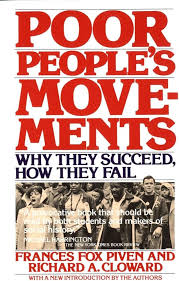
“Disruption makes power visible. When institutions fail to respond to the needs of the poor, mass pressure forces change.”
Source context and analysis in our op/ed. For related primary materials, see the Maryland testimony PDF and historical references cited below.
“A massive increase in welfare rolls would produce a profound financial and political crisis. Local relief programs would collapse under the weight of their own obligations.”
This quote summarizes the core of the Cloward–Piven strategy: overload the system to force central intervention and expanded federal power.
When Piven and Cloward organized protests, welfare drives, and income campaigns, they made clear that success meant the system failing. A broken system, they believed, would guarantee the birth of socialism.
The 2020s: Same Game, Bigger Scale
America is watching that experiment unfold again. Cities are drowning in entitlement debt, migration pressure, and bureaucratic paralysis. Every new expansion—whether it’s housing for migrants or “emergency” SNAP funding—tightens the loop between local collapse and federal dependency.
The lesson is simple: the Cloward–Piven Strategy never died—it evolved. It’s alive every time Washington steps in to “fix” the problems its own policies helped create.
Editorial Closing
America was never meant to run on chaos and crisis. Cloward and Piven believed destruction was progress. They saw collapse as the path to equality. But equality built on ruin isn’t justice—it’s control. The greatest act of rebellion today is restoring limits, enforcing borders, and rebuilding accountability before the system they designed finishes its work.
by Sack Head Shaun
Host of The Edge of Liberty
SHR Media, 2025 — All Rights Reserved.
Sources
- Cloward & Piven, “The Weight of the Poor: A Strategy to End Poverty,” The Nation, 1966
- Maryland General Assembly – Cloward-Piven Testimony (PDF)
- AMAC Newsline – “Cloward-Piven: The Strategy Being Used Against America”
- USDA Food and Nutrition Service, FY2024 SNAP Data
- NYC Mayor’s Office, FY2023–2025 Asylum-Response Budget Reports
- Congressional Budget Office, The Effects of Immigration on State and Local Budgets
About the Author

Discover more from SHR Media
Subscribe to get the latest posts sent to your email.