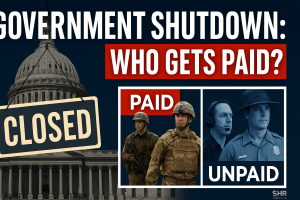
Who really gets paid when Washington shuts down? Jersey Joe explains in this Reaver of Common Sense special.
When Washington grinds to a halt, ordinary Americans pay the price. While politicians argue over spending bills and deadlines, hundreds of thousands of federal workers face lost paychecks, delayed benefits, and mounting uncertainty. Yet many Americans still don’t fully understand what actually happens when the government shuts down. The details of government shutdown pay are explained vaguely, leaving questions about why some people keep getting paid while others don’t.
That’s the question Jersey Joe tackles in his new Reaver of Common Sense special, “What Happens During a Government Shutdown: Who Gets Paid and Who Doesn’t,” premiering today at 2PM EST on SHR Media.
The episode breaks down the chaos behind the headlines and explains in plain English how shutdowns start. It covers which laws dictate federal spending, and how the government decides who is “essential” enough to keep working when funding stops. In short, it covers how government shutdown pay is explained to the public.
The Reality of a Shutdown
A government shutdown happens when Congress fails to pass a spending bill or continuing resolution. Without those funds, the law — specifically, the Antideficiency Act prevents most agencies from operating. Only “essential” services, like national security, air traffic control, and border protection, continue.
That means millions of Americans, from National Park rangers to IRS clerks, are suddenly sent home without pay. Meanwhile, essential personnel such as TSA agents, the military, and federal law enforcement must keep working. For weeks, they often work without a paycheck, leading to confusion on how government shutdown pay is handled during these times.
To make matters worse, Congress and federal judges continue to be paid during every shutdown. This is thanks to constitutional guarantees that protect their salaries. It’s a stark contrast that fuels public anger year after year.
The Hidden Economic Impact
In his presentation, Jersey Joe also highlights the ripple effects that stretch far beyond Washington. Federal contractors, small businesses near government facilities, and even local economies feel the pinch as spending dries up. The explanation of the economic impact is crucial to understanding the broader effects of a government shutdown.
During the 2018–2019 shutdown the longest in U.S. history economists estimated an $11 billion hit to the U.S. economy. There were $3 billion in losses that were never recovered. For many families, those weeks meant maxing out credit cards or turning to food banks just to get by.
Watch: What Happens During a Government Shutdown — Who Gets Paid and Who Doesn’t (Reaver of Common Sense | SHR Media)
Who Deserves to Be Paid?
As Jersey Joe explains, every shutdown exposes a deeper issue: Washington’s priorities. If our soldiers, air traffic controllers, and border agents are “essential” enough to protect the country during a shutdown, shouldn’t they also be guaranteed their pay on time? This raises questions about how the government shutdown pay should be explained and handled.
The episode ends by asking viewers a direct question who do you think should still get paid during a shutdown? It’s a challenge that goes beyond politics, calling for fairness and accountability from a government that too often forgets who it serves.
Outbound Links
👉 Read more about: Arnold Schwarzenegger on Partisan Gerrymandering: A Closer Look
By Jersey Joe | Host of Reaver of Common Sense on SHR Media
(All information verified through public records, budget data, and reporting from the U.S. Office of Personnel Management, CBO, and GAO.)
Don’t forget to follow Jersey Joe on X or SHR Media for updates and live show announcements.
© 2025 Jersey Joe | SHR Media. All rights reserved.
About the Author

Discover more from SHR Media
Subscribe to get the latest posts sent to your email.