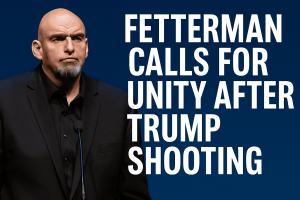
In a rare public address that left the Kennedy Center audience in hushed silence, Senator John Fetterman appealed to Americans to reject extremism, name-calling, and political demonization. He emphasized that voters on all sides are human beings with dignity and urged cooler heads to prevail in an era of deep polarization.
“I know and I love people who voted for President Trump. They are NOT fascists, they’re NOT Nazis, they’re NOT trying to destroy the Constitution.”
“I REFUSE to call people Nazis or fascists. I would never compare anybody anybody to Hitler.”
“Like Charlie Kirk, all I could say is let people grieve give people the space. I’m not going to use that terrible thing and that assassination to make my argument and try to put out my views.”
“It’s like, my God, he’s a father that had his neck blown out by a bullet. And now people have forgotten: President Trump was in my state was shot in the head. Could you imagine where our nation would be if he were hit in the same way as Kirk? We really got to turn the temperature down.”
Context & Setting
The remarks came amid a contentious political climate, following an incident involving Charlie Kirk and renewed intensity in political rhetoric. Fetterman’s address clearly sought to deescalate the environment, reminding listeners of the human cost of violent imagery and rhetorical extremism.
Although I normally do not agree with Senator Fetterman on many issues, I believe this moment deserves credit: he offered a measured, empathetic message at a time many are shouting past one another.
Analysis: Why This Speech Matters
1. A shift in tone amid extremism
Political discourse in recent years has increasingly turned to hyperbole labeling opponents as “fascists,” “Nazis,” or intent on destroying the Constitution. That kind of language is rarely recanted; once used, it colors future debates. Fetterman’s explicit rejection of that tactic is notable especially coming from a vocal figure known for blunt rhetoric himself.
2. Targeting both sides, not just one
Fetterman didn’t reserve his appeals for those who agree with him; he directly addressed supporters of Donald Trump, saying they are not extremists or traitors. That approach risks criticism from those who prefer sharper binaries, but it attempts to reintroduce the notion that political opponents are still citizens.
3. Risk vs. reward for political identity
Given Fetterman’s alignment with progressive policy in many settings, this kind of conciliatory speech could alienate parts of his base. Yet, it may also earn cross-aisle respect and appeal to moderates fatigued with acrimony. The speech underscores a balancing act: maintain ideological identity while avoiding dehumanization of opponents.
4. The power of symbolic moments
We shouldn’t overstate results from a single speech. Symbolism alone doesn’t dismantle systemic polarization. But in moments when media cycles tend to amplify outrage, a call for restraint stands out. The silence in the auditorium is itself a signal people recognized the weight of what was being said, at least temporarily.
Potential Critiques & Challenges
- Efficacy: Some will argue that statements of unity don’t alter the incentives in politics. Partisan actors may continue exploiting division for fundraising, media, and mobilization.
- Credibility: Critics might point to Fetterman’s past embrace of harsh rhetoric, inconsistent behavior, or missed votes as undermining the force of this moment.
- Sustainability: This kind of tone must be backed by consistent behavior. One speech won’t hold if future actions revert to name-calling and confrontation.
Reactions & Broader Landscape
While there’s no comprehensive media record yet confirming how every political actor responded, such addresses often spark commentary. Some will praise the tone; others will question motivations or point to previous contradictions.
Fetterman’s evolving posture sometimes crossing from party lines, sometimes defying expectations positions him as a somewhat unpredictable voice in the Senate.
In broader terms, the address reflects a growing recognition among some elected officials that the current climate may be unsustainable. Whether more will follow in Fetterman’s footsteps remains to be seen.
Conclusion
Senator Fetterman’s Kennedy Center address is unlikely to resolve America’s deep political divides, but it’s a moment worth noting: a powerful, empathetic plea not to dehumanize political opponents.
Again, though I often disagree with him, this speech calls for credit because in a time of shouting matches, someone must make the effort to remind us that civility and respect are not signs of weakness, but of character.
If we want a healthier democracy, speeches like this need not just applause they need follow-through.
About the Author

Discover more from SHR Media
Subscribe to get the latest posts sent to your email.