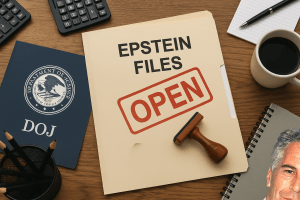
A top down view of a busy DOJ style desk with a file labeled Epstein Files stamped Open. Alt text: Top down view of a busy desk with a DOJ folder, a stamped file labeled Epstein Files Open, office supplies and space left for a mugshot folder.
It’s Now Law
President Trump has signed a new law that requires the Department of Justice to release all unclassified records connected to the federal investigation and prosecution of Jeffrey Epstein. The bill passed both chambers of Congress with bipartisan support.
What The Law Says
Under the law, the Department of Justice must publish all unclassified documents, communications and investigative materials related to Epstein in a searchable and downloadable format. The release will include materials related to Ghislaine Maxwell, flight logs and travel records and the names or references of individuals connected to the Epstein investigation. The requirement covers government officials and politically exposed individuals.

The Department of Justice is permitted to withhold limited categories of information. This includes personal information of victims and any materials that could impact an active federal investigation.
No later than fifteen days after publication, the Department of Justice must send Congress a report that lists every category of information released and withheld. The report must also include a summary of all redactions and a list of government officials and politically exposed individuals who appear in the published materials.
What Remains Sealed
As of November 2025, several parts of the Epstein case remain sealed under orders issued by federal judges in New York and Florida.
U.S. District Judge Richard M. Berman haskept specific records sealed in the Southern District of New York, including grand jury transcripts and exhibits from Epstein’s criminal case. Judge Berman ruled that federal law places strict limits on the release of grand jury materials and said disclosure could threaten the safety and privacy of victims. He also ordered the continued sealing of the identities of two individuals who appeared in court filings as possible co conspirators but were later determined to be victims who faced credible threats.
U.S. District Judge Paul A. Engelmayer denied a request to unseal grand jury materials related to the case of Ghislaine Maxwell. He noted that the legal standards for releasing grand jury records had not been met and that much of the relevant evidence was disclosed publicly during Maxwell’s trial.
U.S. District Judge Robin Rosenberg in the Southern District of Florida denied a similar request involving grand jury materials linked to federal investigations of Epstein in Florida in 2005 and 2007. She cited Eleventh Circuit precedent that permits disclosure only under extraordinary exceptions, which the request did not meet.
What Happens Next
With the bill now signed into law, the Department of Justice will begin preparing the required public release of unclassified Epstein records. Once published, the documents will be accessible in a searchable online format. Within fifteen days of that publication, the Department of Justice must deliver a full report to Congress.
SHR Media will continue to follow the implementation of the law and will provide updates as the records are released.

SHR Media Staff
The SHR Media Staff is a dedicated team of journalists and creators providing primary source reporting and constitutional perspective on today’s top stories. Our mission is to deliver straight news and insightful commentary across the SHR Media Network.
About the Author

Discover more from SHR Media
Subscribe to get the latest posts sent to your email.