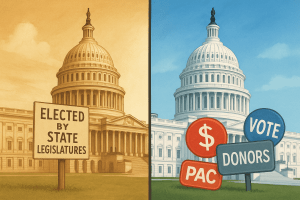
A symbolic depiction of how the 17th Amendment transformed the U.S. Senate — from representing state legislatures to chasing donors and popular votes.
By Sack Head Shaun
How the 17th Amendment Hijacked the Founders’ Design
The Senate was never supposed to be a second House with better chairs. The Framers built a two-chamber system for a reason. The House would reflect the heat of popular passions. The Senate would represent the states as sovereign entities and cool the temperature. Then came the 17th Amendment, and with one “reform,” we traded federalism for vibes and turned the world’s greatest deliberative body into a statewide popularity contest.
Two Chambers, One Electorate — and One Big Mistake
Here’s the blunt version. When state legislatures chose senators, the states had a seat at the federal table. That created a check on Washington that didn’t rely on the latest polling average or whatever a consultant focus group dreamed up last week. After 1913, senators began chasing the same voters the House already chases. Two chambers, one electorate, one set of incentives. If you designed duplication on purpose, you couldn’t do better.

The Progressive Sales Pitch That Sold a Power Grab
The sales pitch for the 17th was high-minded. Direct democracy. Clean government. End the “corruption.” And yes, there were ugly episodes in the Gilded Age. But the cure didn’t just fix a fever. It removed an organ. We lost the structural link between states and the Senate, which means the body that was meant to guard state interests now spends its time guarding reelection calendars.
When Washington Learned to Sell Feelings, Not Facts
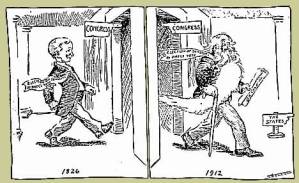
Look at the incentives. A senator once had to explain himself to a legislature that understood budgets, boundaries, and responsibilities. Today he explains himself to a mass electorate that national media can whip into a panic on cue. “If you don’t pass this, everyone will die” is not an argument. It’s an emotional cudgel. It works because the 17th made the Senate respond to emotion instead of state institutions that were built to think beyond a news cycle.
The Four Minute Men: Patriotism in Four-Minute Bursts
Let’s talk architects. Woodrow Wilson loved centralization. He wanted national experts to manage the messy parts of self-government the states kept “complicating.” The 17th cleared a path for that. Once the states lost their lever, Washington could pull more strings. The same era professionalized persuasion. The Wilson administration created the Committee on Public Information to rally opinion for World War I and to normalize the new national mood machine. The CPI’s speakers, known as the Four Minute Men, delivered short emotional speeches in theaters and public halls across America, pushing patriotic unity and suppressing dissent.

Edward Bernays and the Birth of Modern Manipulation
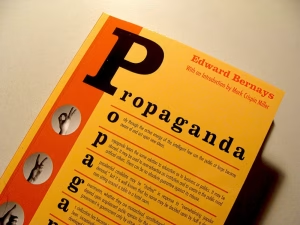
Edward Bernays, who later became known as the “father of public relations,” worked for the CPI during that same period and absorbed its lessons about emotional mass influence. He would go on to blend psychology and marketing, arguing that public consent could be engineered through media and advertising. He believed that shaping opinion was essential to modern democracy, not an abuse of it — a view that fundamentally rewired American political persuasion. It is often reported thatJoseph Goebbels studied or echoed Bernays’ methods; historians dispute the extent.. What’s not disputed is the modern lesson: once you can steer a mass audience, you can steer elected officials who depend on that audience. The 17th made senators more dependent on mood than on states.
From State Power to Donor Power
Defenders say direct election “fixed corruption.” What it fixed, reliably, was accountability to headlines instead of to state governments. Corruption didn’t vanish. It scaled. Now the same national money and national pressure campaigns can work the House and the Senate at once, because both answer to the same emotional weather. That’s not a check. That’s a copy.
The Senate That Forgot Its Job
The result is obvious. Senators today worry more about pleasing donors, courting cable hits, and surviving the next swing-state storm than about protecting water rights, land use, energy grids, and compacts that used to define a state’s actual interests. If the Senate does not represent the states, it represents nothing distinct. It becomes the House with fewer seats and longer terms.
Repeal It and Restore Balance
What should we do? Repeal the 17th. Restore selection by state legislatures. Put the states back in the building the states built. You want real federalism? Give the states a direct veto on Washington’s overreach by giving their governments power over who sits in the upper chamber. You want fewer performative hearings and more serious oversight? Make senators answer to people who read budgets for a living.
Will that fix everything? No. Nothing ensures political virtue. But it restores the missing structural incentive. It makes the Senate different again. Different is the point. Two chambers should not mirror each other. They should check each other.
America was sold a reform that felt good and hollowed out the republic’s backbone. We were told more democracy would save us from the bad men with cigars in smoke-filled rooms. Instead we built a permanent smoke machine for national sentiment and called it progress. The states lost their voice. Washington found its megaphone. That is how you get a government that never stops growing and a Senate that forgets who it is.
Bring back a real Senate. Repeal the 17th. Let the states speak again.
Author and Sources
“Sack Head” Shaun
Shaun is the host of The Edge of Liberty on the SHR Media network and a contributor at TheLoftusParty.com. The opinions expressed in this article are his own and reflect a commitment to primary source research and constitutional literacy.
Support Independent Media – Keep Liberty Alive
Enjoyed this article? At SHR Media we are fully independent and refuse to hide truth behind a paywall. Every piece of our journalism is built for you and by you. If you believe in honest reporting, free speech, and holding those in power accountable, your support matters. Even the smallest contribution helps us fight censorship and shine a light on the stories the mainstream media ignores.
Sources & Context
This episode relies on primary source documents, official government releases and verified independent reporting. SHR Media believes in showing our work. Below are the direct links used in this analysis.
- Founders Online: The Federalist No. 62 (Alexander Hamilton)
- Wikipedia: Four Minute Men
- Smithsonian Magazine: How Woodrow Wilson’s Propaganda Machine Changed American Journalism
- Primary Text: Propaganda – Edward Bernays (1928)
- The Conversation: The Manipulation of the American Mind: Edward Bernays and the Birth of Public Relations
Editorial Disclaimer:
This article reflects the opinion of the author and not necessarily the views of SHR Media, its contributors, or affiliates.
About the Author

Discover more from SHR Media
Subscribe to get the latest posts sent to your email.