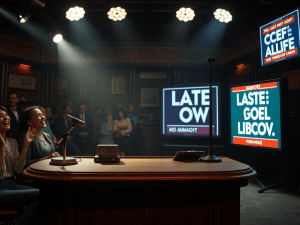
For decades, late night television was a place to escape politics. It was the after hours arena for jokes about both sides, celebrity guests, and a few lighthearted jabs at whoever happened to be in power. But that world is gone. What was once comedy for everyone has turned into a one party echo chamber where every punchline carries a political message, every guest is vetted for ideology, and laughter has been replaced by applause for approved opinions.
The Shift from Jokes to Judgment
There was a time when hosts like Johnny Carson and Jay Leno made it their mission to mock everyone equally. A Republican scandal one night, a Democrat blunder the next. The goal was laughter, not loyalty. Viewers tuned in to unwind, not to be lectured.
That balance started collapsing during the 2010s and by the Trump era, the collapse was complete. Night after night, what used to be comedy became commentary. Monologues turned into political speeches disguised as jokes. Instead of humor that brought Americans together, audiences were divided by ideology.
Jay Leno himself said it best: when you target only one side, you have to be content with losing half the audience. He was right. Once you trade humor for activism, you stop being a comedian and start being a spokesperson.
Late Night Turns Left
Modern late night hosts have abandoned neutrality completely. Their shows now read like coordinated talking points from the same political machine. Each night, the same themes repeat: mock conservatives, praise progressives, and pretend that is comedy.
The opening monologue has become the sermon. The punchline is predictable. It is not about surprise or wit anymore, it is about signaling to the audience that they are on the right side. Viewers who once flipped through the channels for a laugh now face the same uniform message: conservatives are bad, progressives are virtuous, and if you disagree, the joke is on you.
Guests follow the same pattern. Instead of actors promoting movies or musicians sharing stories, we get politicians, activists, and media personalities all reinforcing the same worldview. It is not entertainment; it is repetition.
The Comedy That Forgot to Be Funny
Comedy depends on surprise. It needs the unexpected. When you already know the target before the joke starts, there is no humor left. Late night writers used to find absurdity in everyone. Now they only hunt it on one side of the aisle.
This is not comedy, it is conformity. The moment you can predict every joke, it stops being satire and starts being propaganda. The difference is intent. One aims to make you laugh, the other to make you agree.
The result? Ratings collapse. Viewers are tired of being preached at. When the laugh track turns into applause for the right opinion, you lose the very people who made late night a cultural staple in the first place.
The Colbert Collapse
Stephen Colbert’s exit from CBS in 2026 symbolized the end of the era. Officially, it was a business decision. Unofficially, it was the consequence of one sided politics driving away half the country. The show that once claimed to be truth to power had become a late night lecture hall for one political tribe.
When Colbert attacked the Trump settlement involving CBS’s parent company, the fallout was swift. The network pulled the plug soon after, citing costs and declining revenue. But the timing told the real story. Once you blur the line between comedian and campaigner, you become a liability.
Why the Shift Happened
There are several reasons late night became political theater:
- Polarization: The Trump years gave liberal hosts endless material, and they leaned in hard. The outrage sold clips and went viral.
- Social media metrics: Ten minute anti Trump monologues rack up millions of YouTube views. Balanced humor does not.
- Corporate incentives: Networks now treat talk shows like extensions of their news divisions. The agenda is the same, the packaging just has more jokes.
- Cultural pressure: Hollywood leans left. A host who mocks the wrong target risks cancellation, not applause.
Put together, the result is a late night landscape that no longer entertains America; it lectures half of it.
The Death of Shared Laughter
Once upon a time, comedy was common ground. You could watch the same show, laugh at the same absurdity, and forget about politics for thirty minutes. Now, even laughter has been weaponized.
The danger is not just that one side gets mocked. The real danger is that humor stops holding anyone accountable. When hosts only attack their political opponents, their own side gets a free pass. Hypocrisy goes unchecked. Lies go unchallenged. The comedian becomes part of the machine he used to expose.
That is how propaganda works. It hides inside something you trust. Late night television was once trusted to deliver humor and honesty. Now it delivers ideological marching orders wrapped in punchlines.
The Cultural Cost
This shift has consequences beyond ratings. When entertainment becomes indistinguishable from politics, culture loses its neutral spaces. Everything becomes a battlefield. The shows that once helped America unwind now help keep it divided.
You cannot unite a country with laughter when the joke is always on the same people. You cannot claim to speak truth to power when you refuse to laugh at your own side. And you cannot claim to be fearless when your writers’ room is terrified of offending the wrong political group.
What late night television once offered was connection. What it offers now is compliance.
Can It Be Fixed?
Yes, but it requires courage. Real comedians must rediscover the lost art of hitting both sides equally. Networks must stop rewarding political pandering with airtime. Audiences must stop accepting ideological comedy as truth.
A few simple changes could save the format:
- Bring back balance. If you can joke about Trump, you can joke about Biden. If you can roast conservatives, you can roast progressives.
- Diversify the guests. Bring on entertainers, authors, and thinkers from across the spectrum, not just the same recycled list of liberal activists.
- Separate news from jokes. Let the journalists report. Let the comedians entertain. When you try to be both, you fail at both.
- Encourage creative risk. The best comedy offends everyone equally. Fearless humor is the only kind worth watching.
- Embrace independent voices. Online creators, podcasters, and alternative media are proving you can be funny, honest, and uncensored.
The Future of Late Night
If mainstream television refuses to adapt, others will. The rise of independent shows on YouTube, Rumble, and podcast networks is already replacing traditional late night. These new voices are funnier, freer, and far more willing to laugh at everyone.
The future of comedy belongs to those who dare to be unpredictable again. That means rejecting the idea that every joke must serve a message. The best humor exposes hypocrisy, not just the hypocrisy of your enemies.
Conclusion
Late night television was once a mirror that reflected the absurdity of life. Now it is a megaphone that amplifies one narrative. The transition from comedy to conformity has not made the country smarter, only angrier.
When late night hosts stopped making fun of everyone, they stopped being funny. They turned the stage into a pulpit, the audience into a congregation, and laughter into applause for propaganda.
If late night wants to survive, it must rediscover the courage to laugh at everything again, even itself. Until then, it remains exactly what it has become: state media in a suit and tie, hiding behind a laugh track.
Don’t forget to follow Jersey Joe on X @JerseyJoeTalks or Shrmedia for updates and live show announcements.
You might also like our article: “Affordable Care Act premium hike analysis” https://shrmedia.com/2025/10/21/obamacare-2026-premiums-biden-covid-credits-minor-factor/
About the Author

Discover more from SHR Media
Subscribe to get the latest posts sent to your email.