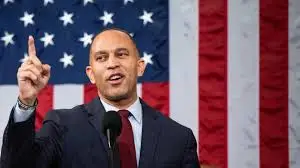
House Democrat Leader Hakeem Jeffries has built his public reputation on condemning what he calls “far right extremism.” However, Hakeem Jeffries warns critics while his recent remarks and political silence on threats from within his own party reveal a troubling double standard that raises serious questions about consistency and accountability in the nation’s political leadership.
Speaking to reporters, Jeffries said, “When it comes to these extremists out there, you better watch how you talk when you talk about me.” The comment came amid heightened political tension following the arrest of a man accused of making threats against Jeffries. But rather than limit his statement to the individual charged, Jeffries framed his warning in broad terms, continuing a pattern of labeling large segments of Republican voters and Trump supporters as “extremists.”
For many observers, this choice of words went beyond defending personal safety. It came across as a threat directed at millions of Americans who disagree with Democrat policies. The implication was clear: criticism of party leadership could now be interpreted as extremism.
Jeffries’ warning also highlights an inconsistency that has plagued Washington’s political discourse for years. While Democrats frequently condemn inflammatory language on the right, they have remained largely silent about similar or worse behavior from within their own ranks.
The latest example centers on Democrat Jay Jones of Virginia. Jones, a former delegate and once a rising figure within the party, recently faced backlash after his remarks that critics called threatening and irresponsible. Despite calls from community leaders and voters for accountability, Jeffries has not publicly condemned Jones or demanded that he withdraw from his campaign.
This silence stands in sharp contrast to the fierce condemnations Democrats often deliver when Republicans are accused of using divisive rhetoric. When a conservative figure uses harsh language, the response is swift and absolute. Media outlets, commentators, and party spokespeople call for resignations and investigations. Yet when a Democrat crosses the line, the reaction is muted or absent altogether.
That double standard undermines the credibility of political leaders who claim to defend civility. Jeffries has been one of the most vocal voices warning about threats to democracy, often portraying Trump supporters as dangerous radicals. However, his refusal to speak out against threats and intimidation from within his own party weakens that message.
The record shows that violence and intimidation have not been limited to one side of the political spectrum. Over the past several years, conservative speakers have been shouted down at universities, businesses supporting traditional causes have faced vandalism, and activists have been attacked for expressing political views. The 2020 riots that caused billions of dollars in damage across American cities are still fresh in public memory. Yet those incidents receive little attention or condemnation from the same leaders who now lecture about extremism.
Jeffries’ latest statement reflects a broader cultural shift in American politics where criticism of Democrats is increasingly portrayed as dangerous. Terms like “threat,” “extremist,” and “insurrectionist” are being applied not to acts of violence, but to ordinary political dissent.
Political analysts note that this rhetoric is not accidental. It creates a narrative that allows Democrats to claim moral superiority while avoiding accountability for behavior on their own side. By defining political disagreement as extremism, they can delegitimize opponents without addressing policy failures.
In Jeffries’ case, this approach has become a consistent theme. Since taking over party leadership, he has repeatedly framed Republicans as threats to democracy. He has accused them of enabling authoritarianism and spreading hate. But when presented with examples of violence and threats from Democrat supporters, he either deflects or remains silent.
The Jay Jones controversy offers a clear example. Jones’ remarks were widely viewed as threatening toward opponents, yet no senior Democrat has called for his removal from the race. Instead, party leaders have attempted to shift focus toward unrelated issues or claim the remarks were misunderstood. The lack of accountability sends a message that threats from the left are tolerable as long as they target the right.
This selective outrage weakens the moral authority of leaders like Jeffries who claim to stand for unity and safety. It also deepens the country’s divisions by signaling that justice and condemnation depend on political alignment rather than consistent standards.
Critics argue that if Jeffries truly cared about lowering political tensions, he would apply the same expectations to members of his own party. Condemning threats should never depend on which side makes them. When a Republican crosses the line, Democrats are quick to demand apologies and resignations. The same should be true for Democrats who engage in threatening rhetoric.
Moreover, the pattern of silence from the top reinforces a culture of impunity. Party leaders often claim that a few individuals do not represent their movement. Yet by refusing to confront those individuals publicly, they allow the perception that threats and intimidation are acceptable tools of political engagement.
The danger of this approach goes beyond party politics. When citizens believe that justice and accountability are determined by political power, faith in democratic institutions erodes. The rule of law and the right to free speech depend on equal standards, not selective enforcement.
Jeffries’ warning to “watch how you talk” captures the tension at the heart of modern American politics. On one side are leaders demanding respect and safety while branding their critics as extremists. On the other side are citizens who believe that calling out hypocrisy is part of a healthy democracy.
It is not extremist to question leadership or challenge policy decisions. It is not extremist to demand that public officials apply the same standards to their allies that they impose on their opponents. It is not extremist to expect that threats of violence, regardless of political source, be condemned without exception.
The failure to maintain those principles invites more division and distrust. Every time a leader like Jeffries dismisses threats from the left while condemning words from the right, it signals to Americans that fairness has become conditional.
In the end, the real danger to democracy does not come from ordinary citizens expressing political opinions. It comes from leaders who manipulate language to protect their power while ignoring misconduct among their own.
If Jeffries wants to be taken seriously as a defender of democracy and public safety, he must begin by holding his own party to the same standard he demands of others. Silence in the face of threats from allies is not leadership. It is complicity.
The American people deserve leaders who condemn violence and intimidation wherever they occur. Anything less turns democracy into a partisan weapon instead of a shared principle.
Until that happens, Hakeem Jeffries’ words will continue to sound less like a call for safety and more like a warning to stay quiet.
About the Author

Discover more from SHR Media
Subscribe to get the latest posts sent to your email.